,hl=en,siteUrl='http://0ldfox.blogspot.com/',authuser=0,security_token="v_SeT2Tv8vVdKRCcG9CCW-ZdIfQ:1429878696275"/> Old Fox KM Journal

Tuesday, August 05, 2003


Babe Kylie's simply botiful



Bum's the word ... Kylie in today's Sun
Click picture to enlarge
By DOMINIC MOHAN
The man who's touched it


THIS must rank as one of the wonders of the world ... Kylie Minogue’s bottom.

I should know — I’ve touched it. And I can confirm her bum is the most sumptuous in showbusiness.

Now I don’t want you thinking I’m some kind of perv. It was an accident, honest.

Kylie was dancing at a party after a gig at London’s Hammersmith Apollo when my hand connected with her rear.

Much booze had been consumed by both of us and as I stumbled across the dancefloor she backed into me.

It all happened very quickly but my hand rested there long enough to make an assessment. I had expected her bum to be bony. But it was soft like a ripened fruit.

I apologised profusely and walked off. Later I looked down at my right mitt. Raising it skyward. I screamed: “Yesssss.”

Several months later, I was interviewing Jennifer Lopez. As we rose from the sofa at the end of our chat, my hand brushed against America’s most famous butt. J-Lo’s cheeks are larger, like a pumped up version of her Aussie rival’s. ims could not manifest warmth in the dungeon that was my soul. And thus I conclude, "for every up there is a down, for every smile there is a frown, and thats what makes the world go round!" (an excerpt of the song from Disney's 'Sword in the Stone'). Maybe for people with more internal pressure, the homeostasis never really hits neutrality. This is especially true for younger people.

Children have alot of passion. Passion creates energy. Energy builds internal pressure, and that is why children are never quite what we percieve as "normal". They always do things in extremes....when they play, when they talk/scream, when they eat....even their thinking is rather eccentric and is inevitably cherished by society these days. However their passion is blind passion. Its an instinctive passion. When they h

Monday, August 04, 2003

PRIVACY & SECURITY LAW REPORT
Volume 2 Number 31
August 4, 2003 Page 860
ISSN 1538-3431
News

Spam


Burns Expects Anti-Spam Legislation
To Move to Senate Floor in September


Sen. Conrad Burns (R-Mont.) told reporters July 30 that he expects his anti-spam bill (S. 877) to go to the Senate floor in September without substantial changes.
Burns said the main hurdle will be completing negotiations with Senate Judiciary Committee Chairman Orrin Hatch (R-Utah) to strengthen criminal penalties in the bill.

"That's about the only obstacle we have," he said during a telephone conference with reporters.

Still, Burns said he did not expect many changes in the bill, and he looked forward to seeing it move as soon as the Senate returns from summer recess.

"We've got to take it to the floor," said Burns, who chairs a subcommittee of the Senate Committee on Commerce, Science, and Transportation. "It's got to be passed in September."

A bill introduced by Hatch (S. 1293) would subject violators to up to five years imprisonment. Burns' measure, which is co-sponsored by Sen. Ron Wyden (D-Ore.), currently provides up to one year of jail time.

Hatch has yet to act on his bill, which is focused mainly on setting criminal penalties for egregious spammers. The Burns-Wyden bill, which includes rules for legitimate e-mail marketers, is much closer to a Senate vote. The Commerce Committee approved the bill June 19 (2 PVLR 682, 6/23/03 ). During markup, Burns and Wyden promised to toughen the bill as it reached the Senate floor, but they have not yet offered details on how they would do that.

Sen. Bill Nelson (D-Fla.) is among those on the committee who are pushing for a stronger bill. Nelson has introduced a measure (S. 1052) that would make spamming a felony crime under existing federal racketeering legislation.


Burns Rejects 'Do-Not-Spam List.'

A proposal by Sen. Charles Schumer (D-N.Y.) could be another focus of debate.
Schumer has introduced a bill (S. 1231) that would create a do-not-spam registry, similar to the do-not-call list for telemarketers that was launched by the Federal Trade Commission in June.

While Schumer's bill appears to be gaining support among consumers, it has only one Senate backer. Despite that, Schumer has said he plans to introduce the legislation as a floor amendment.

Burns flatly rejected the proposal during his phone conference with reporters.

"Right now, we can't accept that," he said.

The Burns-Wyden bill, as approved by the Commerce Committee, would direct the FTC to study the effectiveness of a do-not-spam list.

So far, members of the commission, including FTC Chairman Timothy Muris, have raised concerns about the idea of creating such a list (see related report in this section ).

The Burns-Wyden bill would allow individuals to send unsolicited commercial e-mail messages as long as they follow certain rules, such as providing a mechanism for individuals to opt out of receiving future messages. The legislation is supported by a number of industry groups, including the Direct Marketing Association.

Besides creating a do-not-spam list, Schumer's bill would provide a private right of action for individuals, another feature that has made it popular with consumers. The Burns-Wyden bill would only allow the government and Internet service providers to go after spammers.

Copyright © 2003 by The Bureau of National Affairs, Inc., Washington D.C.

Commentary


Stemming the e-mail flood

August 04, 2003 By: Peter A. Steinmeyer

A sharply divided California Supreme Court recently entered the fray over unwanted and unsolicited e-mails, and in the process issued a nearly unlimited license to send unsolicited and unwanted noncommercial e-mails.

In Intel Corp. v. Hamidi, the court held that even when the owner of an e-mail system has expressly told a sender of unwanted, noncommercial e-mails to knock it off, and even when the unwanted e-mails indisputably caused economic harm to the property owner (albeit not physical harm to the e-mail system itself), the e-mail sender did not commit an unlawful trespass by continuing the bombardment. This decision has potentially broad-ranging ramifications, and may further magnify the problem of unwanted and unsolicited e-mails.

What to do about such e-mails is one of the unresolved issues on the cyberspace frontier. Although most states have adopted legislation providing at least some restrictions on unsolicited commercial e-mails, these state statutes generally ignore noncommercial e-mails, even though such e-mails can be very problematic (e.g., racially or sexually offensive jokes), particularly in the workplace setting, where employers strive to provide a harassment-free environment.

One potential remedy for unwanted e-mails is the old common law tort of trespass to chattels, and some courts have applied this tort in the context of unwanted e-mails. After all, most people would assume that if the owner of an e-mail system tells a sender of unwanted e-mails to stop and the instruction is ignored, the owner ought to have a remedy.

The court in Intel, however, held that trespass to chattels is not the appropriate remedy in this circumstance. A former Intel employee had sent mass e-mails to as many as 35,000 Intel employees at their workplace e-mail addresses, even after Intel told him to stop. Intel turned to the judicial system for relief, ultimately proceeding on a trespass-to-chattels claim. To establish harm and a basis for injunctive relief, Intel stressed the loss of employee productivity it suffered resulting from 48,000 to 210,000 e-mails.

Although one of the concurring justices expressed sympathy for Intel, by a 4-3 vote the court concluded that Intel did not have a claim for trespass to chattels because it did not show that the e-mails caused physical damage or functional disruption to Intel's e-mail system, or somehow deprived Intel of its use.

In so ruling, the court set the burden too high. As one of the dissenting justices, Janice R. Brown noted, the majority’s decision seemingly provides a right to spray-paint political graffiti on the bumper of an opposing candidate’s vehicle, so long as the spray paint is water-soluble.

The majority concluded that no harm was done to Intel’s computer system. But this ignored the negative economic consequences of mass unwanted e-mails. Such a harm ought to be sufficient to support a trespass-to-chattels claim, as well as a means of distinguishing the Intel scenario from a few unwanted phone calls. As discussed in the Second Restatement of Torts, “there may ... be situations in which the value to the owner of a particular type of chattel may be impaired by dealing with it in a manner that does not affect its physical condition. … In such a case, the intermeddling is actionable even though the physical condition of the chattel is not impaired.” As an example, the restatement mentions the value of one’s toothbrush after it has been used by another. It has suffered no physical harm, but it will never again have the same value. So, too, with an e-mail system vulnerable to repeated waves of mass unwanted e-mails.

The restatement also points out that a person commits an actionable trespass to chattels if, by his trespass, he “causes harm to any person in whom the possessor of the chattel has a legally protected interest.” Employers have a legally protected interest in their relations with their employees; for example, one cannot tortiously interfere with that relationship. An unwanted e-mail sent to an employee’s workplace e-mail address that causes harm to that employee (e.g., by wasting the employee’s time) or causing anger or fear (in the case of a harassing e-mail) should satisfy the restatement’s definition of harm.

Even if the existing common law tort of trespass to chattels is not broad enough to encompass the wrong suffered by Intel, then perhaps this is one of those situations where the common law needs to evolve to meet the challenge of a new technology.

One justice in the majority, Joyce L. Kennard, invited a legislative solution that would balance the competing interests at stake. But in the meantime, an otherwise viable common law remedy has been declawed in California.

— Peter A. Steinmeyer


American Lawyer Media, Inc. takes copyright infringement seriously. YOU MAY NOT DISTRIBUTE THIS STORY, ELECTRONIC OR OTHERWISE, WITHOUT OUR PERMISSION. You may print or purchase this story from our archives for your personal use only. In order to obtain reprint permission rights, please contact Sue Viera at 305-347-6621 or 800-777-7300 ext. 6621. If you need a subscription, please call 1--877-347-6682.


Misguided Libertarians Are Hindering War On Terrorism


By Stuart Taylor Jr., National Journal
© National Journal Group Inc.
Monday, Aug. 4, 2003

A civil-libertarian backlash against the USA PATRIOT Act is gathering steam. More than 140 cities and communities in 27 states have passed resolutions opposing it, according to the American Civil Liberties Union. The ACLU itself has intensified its nonstop barrage, filing a lawsuit on July 30 challenging the constitutionality of one of the act's most far-reaching provisions, and airing TV ads that warn of government spies secretly searching homes. Some librarians say they are destroying records to prevent the feds from tracking patrons' book borrowing and Internet browsing.

We should be making it easier, not harder, for intelligence agencies to protect us.

Even Congress, which overwhelmingly adopted the 156-section counter-terrorism statute six weeks after the September 11 attacks, without most members having read it, is showing signs of buyer's remorse. On July 22, the House in a 309-118 vote adopted an appropriations rider to bar the government from invoking the PATRIOT Act to search a home or business without immediately notifying the occupants. Conservative Republicans, including the sponsor, Rep. Butch Otter of Idaho, joined by the ACLU, cheered this vote as a mighty blow against "sneak-and-peek" searches. The Justice Department denounced it as a "terrorist tip-off amendment."

Do 309 House members really want to require the FBI to leave a nice note for the next Mohamed Atta, if and when agents have a chance to sneak into his motel room and copy computer files detailing the identities of his co-conspirators? It's not easy to tell: The platitudinous floor debate left unclear whether the purpose is to bar all delayed-notice searches, despite decades of judicial precedent upholding such searches under some circumstances, or just to roll the clock back to before the PATRIOT Act. Otter demonstrated his own command of the subject by claiming that Section 213 "allows the CIA and the NSA to operate domestically." Wrong.

The Senate has also been doing its part to make it harder for the government to find suspected terrorists. On July 17, it voted to cut off all funding for the Pentagon's Terrorism Information Awareness program. Formerly named Total Information Awareness (and unrelated to the PATRIOT Act), this nascent research project into possible uses of "data-mining" and other sophisticated computer technology to find terrorists before they strike has been the focus of a storm of ill-informed Big-Brother-is-about-to-be-watching-you hype. But the most immediate impact of a funding cutoff would be to curtail development of software that would link counter-terrorism agencies' databases to facilitate information-sharing and the like.

This at a time when the congressional Intelligence committees are slamming those same agencies for failing to share information that might have enabled them to prevent the 9/11 attacks! In their 850-page report (PDF), released on July 24, the committees complained of intelligence agencies' "reluctance to develop and implement new technical capabilities aggressively." How are the agencies supposed to do that if Congress kills TIA?

Are Congress and the American people at least waking up to the most insidious Bush administration threats to our freedoms? Not really. Congress has virtually ignored the biggest danger: the administration's incarceration of suspected "enemy combatants" without charges, access to lawyers, or meaningful judicial review. Instead, Congress and many civil libertarians have misdirected their zeal by mischaracterizing the PATRIOT Act's largely reasonable and incremental expansions of the investigative powers that are the government's main hope of catching would-be mass murderers before it's too late.

A recent ACLU fundraising letter, for example, claims that the PATRIOT Act includes "a provision that might allow the actions of peaceful groups that dissent from government policy, such as Greenpeace, to be treated as 'domestic terrorism.' " This is flat-out false. The act's definition of domestic terrorism (Section 802) covers only criminal activities that are, among other things, "dangerous to human life."

Such scare tactics appear to have succeeded, for now, in preventing Congress from granting the administration additional new powers, such as a much-needed proposal to make clear the FBI's authority to search the possessions of the next Zacarias Moussaoui, the suspected "20th hijacker," who was in custody (but unsearched) for weeks before 9/11. Libertarians are also intent on blocking re-enactment of the many important PATRIOT Act provisions that will sunset in 2005.

This is not to deny that some sections of the law authorize significant invasions of privacy for the sake of difficult-to-gauge benefits in preventing terrorist attacks. The most problematic is Section 215, the one challenged in the new ACLU lawsuit. It expands FBI agents' powers, in the course of authorized foreign-intelligence investigations, to inspect without notice and copy records about innocent individuals (as well as suspected terrorists) held by colleges, libraries, hospitals, nonprofits, mosques, Web sites, businesses, banks, and other organizations, and to use gag orders to prevent anyone from telling the targets. Other arguably overbroad provisions are Section 218, which allows investigators to use the search powers provided by the Foreign Intelligence Surveillance Act, even when their primary goal is to find evidence of ordinary crimes, and Section 411, which can be read as authorizing deportation of aliens for innocent associations with terrorist groups.

Even these broad new powers may well be justified by the unprecedented threats we now face. Many libertarians draw exactly the wrong lesson from the Intelligence committees' account of the government's failure to prevent the 9/11 attacks. The report's catalog of human errors, the ACLU asserts, shows that "the government does not need additional new law enforcement powers."

The opposite is true. Intelligence agencies will never be infallible. We should be making it easier, not harder, for their imperfect agents to protect us. Misguided and outdated rules imposed on the intelligence agencies in the name of civil liberties before 9/11 contributed to their failure to prevent the attacks. In particular, the so-called legal "wall" between intelligence and law enforcement agencies helped foster the notorious reluctance of the CIA and FBI to share information.

The PATRIOT Act opened the way for better information-sharing by largely dismantling this wall -- with the help of a decision last November by the special Foreign Intelligence Surveillance Court of Review. The statute also extended to terrorism investigations some powers that prosecutors had long used in drug and organized-crime cases and updated anachronistic electronic surveillance rules to catch up with new communications technologies.

As for the dreaded "sneak-and-peek" provision (Section 213), the claims that it trashes the Fourth Amendment are far-fetched. Federal courts, including the Supreme Court, have authorized such searches for decades in circumstances in which immediate notification might defeat the purpose of the surveillance, including all wiretaps. Section 213 codified a legal standard similar to that used by the U.S. Court of Appeals for the 2nd Circuit, in Manhattan. While the Section 213 standard is more favorable to prosecutors than those used by some other courts, it is hardly a blank check: Notice may be delayed only for as long as "reasonable," and only when necessary to avoid endangering "life or physical safety," intimidation of witnesses, tampering with evidence, flight from prosecution, or "otherwise seriously jeopardizing an investigation or unduly delaying a trial."

The PATRIOT Act has also been blamed for detentions and other possible abuses that are completely unrelated to it. Consider the front-page New York Times article on July 21 hyping a leaked report to Congress by the Justice Department's inspector general. The article trumpeted (unproven) complaints by Arab and Muslim prisoners of "serious civil-rights and civil-liberties violations involving enforcement of... the USA PATRIOT Act." But these complaints -- mainly of beatings and verbal abuse by guards -- had nothing to do with enforcement of the PATRIOT Act. Its only relevance was that this report would not have been written at all but for Section 1001, which requires periodic reports to Congress of any and all civil-liberties complaints about Justice Department employees.

We need less media misinformation, less libertarian hysteria, and more judicious congressional oversight of the (unfortunately uncooperative) Justice Department. The PATRIOT Act's critics have pointed to precious little evidence that it is anything like the engine of McCarthyite witch-hunts they depict it to be. And while a few sections do pose some risk of overly intrusive FBI spying, there are worse things than that. One of them is being murdered by terrorists.

Stuart Taylor Jr. is a senior writer for National Journal magazine, where "Opening Argument" appears.
REVIEW & OUTLOOK
[from the online WallStreet Journal]

MiGs in the Sand

They didn't get much attention, but two events last week shed light on the continuing search for weapons of mass destruction in Iraq. David Kay, the former chief U.N. weapons inspector now leading the WMD search, told a closed-door briefing on Capitol Hill that "solid progress" is being made. "We're building a solid case that will stand," he said after the briefing, "and we welcome international scrutiny of that case after we have the evidence assembled."

At about the same time, coalition teams looking for WMD found dozens of Iraqi air force fighter jets buried beneath the sands at an airfield west of Baghdad. AP cites a Pentagon official who said the searchers noticed a pair of tail fins poking up in the sand. They turned out to belong to a Cold War-era MiG-25.

If it's possible to hide 30-plus aircraft for several months with 150,000 troops on the lookout, secreting vials of poison gas or anthrax has to be a cinch. Search teams are unlikely to stumble upon BW or CW by chance. Mr. Kay's comment that Iraqi scientists are "collaborating and cooperating" is encouraging, because such intelligence is the way we are likely to discover what Saddam Hussein was really up to.

One question, however, is whether some war critics will even believe such proof when they see it. After hearing Mr. Kay's testimony, Senator Ted Kennedy rushed out to say that, "It's looking more and more like a case of mass deception." He was referring to President Bush, not Saddam. So much for waiting for the evidence.

Updated August 4, 2003

Saturday, August 02, 2003

Mr. and Mrs. Clinton were in the front row at a Yankees game. The row behind them was taken up with Secret Service agents. One of them leaned over and whispered in the President's ear. Mr. Clinton paused, then grabbed Hillary by the scruff of the neck and heaved her over the railing. She fell 10 feet to the top of the dugout, screaming obscenities.

The President shook the hands of those near him and got high fives all around.

The Secret Service agent leaned over again and whispered, "Mr. President, I
said it's time to throw out the first pitch."
Tweaked some formatting.

Friday, August 01, 2003

Captured Al Qaeda Recruitment video

Kylie so happy with Olivier


By VICTORIA NEWTON

KYLIE Minogue yesterday dismissed rumours her lover has fallen for movie babe Angelina Jolie — and said: “I’m so happy with him.”

The Aussie pop princess admitted she had read reports linking hunky Olivier Martinez and Tomb Raider star Angelina, with whom he is shooting a film.

But after jetting out to Canada to see the handsome French actor, Kylie spent two nights with her man.

Olivier wined and dined her at cosy tables for two. And Kylie, 34, declared she had “no worries” about their future.

The singer — arriving home in West London yesterday — said: “I’m so happy right now.

“I love every minute I spend with Olivier. I had a couple of days off so I packed an overnight bag and flew to Montreal.

“Of course I am aware of what had been written in the Press, but this trip was like the previous three I’ve made to Montreal to visit my boyfriend while he’s filming.”

She added: “We’re both busy but make time to be together. Things couldn’t be better.”

Kylie met Olivier in the lobby of a Los Angeles hotel in March. Their relationship began shortly after Kylie’s ex, model James Gooding, sold secrets of his romance with her to a newspaper.

Olivier, 37, is currently filming Taking Lives with 28-year-old divorcee Angelina. The pair were spotted watching baseball with Angelina’s adopted son Maddox.

Click here for bigger pix

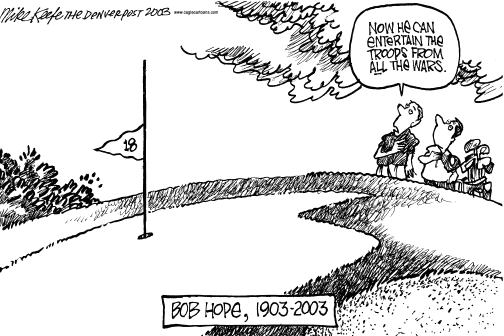
Mike Keefe, The Denver Post -- -- Mike's award winning work has appeared in the Post for more than 20 years --visit Mike's web site.

Thursday, July 31, 2003

A Gay High School in New York:
rambling comments:

What is the entrance exam like?

Can you be bisexual, sexually confused, a straight transvestite? And besides I have seen plenty of homosexuals who are bullies and live thier lives insulting and trying to make others feel ashamed or uncomfortable. Rex Reed, Roy Cohn, Naughty Norton, virtually every movie critic. In fact they'll be all picking on the fat, messy kid with poor taste in clothes that like country music.

This will never fly. If it flies for one year like the Bring Your Daughter to Work Day did, it will be defeated when a group forms a Puerto Rican school, a Catholic school, a Arab-American school, or a Children of Broken Homes School. True it wil take the courts two or three years to shut it down and they will have a run for that long, but how dumb!

"Don't Ask, Don't Tell" but he came from Harvey Milk High School, Sergeant!

I wonder which health insurance carrier is going to be rushing over there to set up the Group Policy, solid as the rock? Good hands? The Firestone Rubber Company?

Who wants to be the guidance counseller at Harvey Milk High School? Dairy Queen?
We put the seconds into Secondary Education.
We put the tension in detention.
We put the dick in valedictorian!
We got more cum in magna cum laude.
Summa cum lauder than others.

"Help? My mother made me a queer!"
'If I give her the wool, will she make me one?'

Please someone stop me, I can't control myself!!!!


---- Original Message -----
From: Richard
To: redacted
Sent: Tuesday, July 29, 2003 6:44 PM


From the NY Daily News....

Mike Hails Gay H.S As A Shelter From Bullies

"Mayor Bloomberg is defending a plan to open the city's first entire high school for gay students, touting it yesterday as a haven from bullies. The Harvey Milk High School is scheduled to open in the fall at 2 Astor Place in the East Village with an initial enrollment of about 100 students after a $3.2 million renovation."
Mike Hails Gay H.S As A Shelter From Bullies

Of course, for $3.2 million, you could hire personal body guards for every one of those kids at 32 large a pop. Or, you could round up the bullies and throw them out of school --- that would be free.

Didn't the ACLU sue the city when they tried to open a school for girls in Harlem after studies showed that girls did better academically in an all girl environment? Does anyone remember if that school ever got opened? Because if it didn't, this new school sure as hell shouldn't be opened.

The future possibilities are endless......

Fat Albert High
Bad Complexion High
Speech Impediment High
Yo Mama is Ugly High

You KNOW that the only reason Bloomberg is behind this is because, when he was a kid, he probably got pounded like a Narc at a bikers' rally!

You can't make this stuff up!


******************************************
Richard ...

Wednesday, July 30, 2003

Crimson Trace Lasergrips - Laser gun sights for small arms.

A Letter from Iraq

Crimson Trace -

My name is SSG Sieler. I am currently deployed in Tikrit Northern Iraq in support of Operation Iraqi Freedom with B Company 2-4 Aviation Regiment 4th Infantry Division.

I purchased one of your outstanding sighting systems to go with my Aviation Life Support Equipment. I use it everyday and must say that it is one of the best combat multipliers I have in this combat theater. I must honestly say it has saved lives over here. Not only those of U.S. services members but also the lives of Iraqis.

Often we are faced with tense situations where the "little red dot" makes the difference between the use of deadly force or the power of intimidation. Even with the language barrier the little red dot speaks volumes for us.

I'm sure you have had soldiers here try to contact you to purchase ones for themselves, as everyone I run into loves mine. The environment here is extremely inhospitable and my M-9 takes a beating on a daily basis. The OPTEMPO in Army Aviation here is staggering and all the aircrews carry the Berretta 9mm. Many soldiers here have bolt-on personal sighting devices but none are as transparent in use, (your grips fit just like the original equipment and never hinder operations as others do) or nearly as durable. Mine has outlasted all the others.

Once again I would like to thank you for an outstanding product. It has made my job that much easier. I have no idea how I ever got along without it.

SSG SIELER
US ARMY
West Group - Password Management Registration: "Password Management allows you to;

Order passwords for new Westlaw users
Deactivate existing passwords
Request replacement password cards by mail
Change the endings of passwords
Print lists of Westlaw passwords for your organization "
Tax Quotes - TaxGaga: "

There is no art which one government sooner learns from another than that of draining money from the pockets of the people.
Adam Smith

--------------------------------------

There are two distinct classes of men... those who pay taxes and those who receive and live upon taxes.
Thomas Paine "
---------------------------------------
MBA Admissions Wire: "MBA Admissions Wire by 'Tad Holbie'
'Tad Holbie's' weblog of his 2002-03 business school application experience. "

Tuesday, July 29, 2003

The life of an ordinary man:

When I was 14, I hoped that one day I would have a girlfriend.

When I was 16, I got a girlfriend, but there was no passion. So I decided I needed a passionate girl with a zest for life.

In college, I dated a passionate girl, but she was too emotional. Everything was an emergency; she was a drama queen, cried all the time and threatened suicide. So, I decided I needed a girl with stability.

When I was 25, I found a very stable girl, but she was boring. She was totally predictable and never got excited about anything. Life became so dull that I decided that I needed a girl with some excitement.

When I was 28, I found an exciting girl, but I couldn't keep up with her. She rushed from one thing to another, never settling on anything. She did mad, impetuous things and made me miserable as often as happy. She was great fun initially and very energetic, but directionless. So I decided to find a girl with some real ambition.

When I turned 31, I found a smart, ambitious girl with her feet planted firmly on the ground and married her. She was so ambitious that she divorced me and took everything I owned.

I am now 44 and looking for a girl with really big tits.

Sunday, July 27, 2003

Saturday, July 26, 2003

3630113

ATKINSON, ROWAN

British Actor

By the mid-1990s Rowan Atkinson had achieved a certain ubiquity in British popular-cultural life, with comedy series (and their reruns) on television, character roles in leading films, and even life-size cutouts placed in branches of a major bank--a consequence of his advertisments for the bank. Yet, despite Atkinson's high profile, his career has been one of cautious progressions, refining and modestly extending his repertoire of comic personae. As one of his regular writers, Ben Elton, has commented, Atkinson is content to await the roles and vehicles that will suit him rather than constantly seek the limelight.

more...

http://www.crissywild.com/pharmacynetwork/pharm1.html#all

another one...no prescription needed...more of a
selection.

from BXK 007
Terry, Check out this link.http://www.tradersnotebook.com/

from BXK 007
= = = = = = = = = = = = = = = = = = = = = = = = = = = = = = = = = =


FREEPINT BAR
In Association with Factiva
a Dow Jones & Reuters Company

Spam seems to have been the topic du jour every day at the FreePint
Bar for a while now. Posters have been wanting to get their
definitions sorted out; defining exactly when commercial email is
unsolicitied <http://www.freepint.com/go/b22997>. After you've
sorted our your 'definitions', you need to address the 'ethics'
of mass mailings <http://www.freepint.com/go/b22544>.

If you're not an instigator but a receiver of spam, then maybe you
should check out the various anti-spamming software and tactics used
by FreePinters <http://www.freepint.com/go/b21850>.

> - - - - - - - - - - - - - - - - - - - - - - - - - - - - - - - - - -

The FreePint Bar is a fantastic free resource where members help each
other with information-related queries <http://www.freepint.com/bar>.

Help for students on information-related courses is available at the
FreePint Student Bar <http://www.freepint.com/student>.

To sit back and let the postings come to you, sign up for the
twice-weekly email digest <http://www.freepint.com/member>.
MY FAVOURITE TIPPLES
By Emma Finney

* If I need music at work I listen to last night's John Peel radio
show from Radio 1 <http://www.bbc.co.uk/radio1/audiovideo/>.

* RDN have developed subject-based tutorials which are perfect for
getting to grips with an unfamiliar subject
<http://www.vts.rdn.ac.uk/>.

* Publist has listings of over 150,000 print and electronic journals
which can be useful for tracking small press publications
<http://www.publist.com>.

* University of Wolverhampton's UK map has direct links to
all Universities and FE colleges
<http://www.scit.wlv.ac.uk/ukinfo/uk.map.html>.

* I confess, I love motor sport and ITV covers better than most
websites <http://www.itv-f1.com/>.

Emma Finney is the Information Adviser for Physics, Chemistry &
Biomedical Sciences at Sheffield Hallam University. She works with
students and academics.

Submit your top five favourite Web sites. See the guidelines at
<http://www.freepint.com/author.htm>.

Friday, July 25, 2003

Worth a visit.
About ARSE
I am Arse, Arse I am. This site is something I do in my spare time when I am not working on commercial projects or collaborating. All work on this site was coded completely by me. Some of the ideas are not original but the code and techniques are all essentially created by me. Should you require Flash or general site design and development then feel free to contact me. I also work with XML, DHTML, ASP, mySQL, and Javascript as well as various design applications such as 3D Studio Max, PhotoShop, Illustrator, Final Cut Pro etc.


Click here to listen to Kylie sing 'Surrender (Talking soul mix)' recorded in 1994 but not released until 2003 [by BMG UK & Ireland Litd.].
KYLIE MINOGUE shows off a massive pair of Gladiator-style boots as she steps out on a shopping trip.

Very few people could wear these clodhoppers and get away with it.

But that didn’t faze Kylie as she walked near her home in West London.


Kylie is a fashion icon. I hope she hasn’t put her foot in it.


Here is Bill Moyers stuck in a time warp of imagination from the 70s still rehashing the same old overhashed and discredited liberal prejudices of his LBJ day.

The viewers and followers of this dumbed down claptrap must all be cut from the cliche of Dharma's dad. Moyers still speaks as if his worlkd view had any credibiltiy and in fact as if it were the main stream of suppositions held by most thinking people.

Listen to this hogwash on the FCC business, "following the FCC action, letters are running 9 to one agianst the change in the rules..."

What BS. That is so crooked it's laughable. 9 to one because there is a campaign. 9 to one because it is done. Overwith. Why would anyone who supports what the FCC has already done bother to write anyone about it? 9ro one. Hah, humbug.


Wednesday, July 23, 2003

"That bitch is a real dog, cats."
The 50's &60's
Were you a kid in the Fifties or so ? Everybody makes fun of our childhood! Comedians joke. Grandkids snicker. Twenty-something's shudder and say "Eeeew!" But was our childhood really all that bad? Judge for yourself:
In 1953 The US population was less than 150 million... Yet you knew more people then, and knew them better... And that was good.
The average annual salary was under $3,000...Yet our parents could put some of it away for a rainy day and still live a decent life... And that was good.

A loaf of bread cost about 15 cents... But it was safe for a five-year-old to skate to the store and buy one... And that was good.
Prime-Time meant I Love Lucy, Ozzie and Harriet, Gunsmoke and Lassie... So nobody ever heard of ratings or filters... And that was good.
We didn't have air-conditioning... So the windows stayed up and half a dozen mothers ran outside when you fell off your bike. And that was good.
Your teacher was either Miss Matthews or Mrs. Logan or Mr. Adkins... But not Ms. Becky or Mr. Dan... And that was good.
The only hazardous material you knew about...Was a patch of grassburrs around the light pole at the corner... And that was good.
You loved to climb into a fresh bed... Because sheets were dried on the clothesline... And that was good.
People generally lived in the same hometown with their relatives... So "child care" meant grandparents or aunts and uncles.. And that was good.
Parents were respected and their rules were law..... Children did not talk back..... and that was good.
TV was in black-and-white... But all outdoors was in glorious color....And that was certainly good.
Your Dad knew how to adjust everybody's carburetor... And the Dad next door knew how to adjust all the TV knobs... And that was very good.
Your grandma grew snap beans in the back yard...And chickens behind the garage... And that was definitely good.
And just when you were about to do something really bad... Chances were you'd run into your Dad's high school coach... Or the nosy old lady from up the street... Or your little sister's piano teacher... Or somebody from Church... ALL of whom knew your parents' phone number....And
YOUR first name... And even THAT was good! ~ ~ ~ ~ ~ ~ ~ ~ ~ REMEMBER......
Send this on to someone who can still remember Nancy Drew, The Hardy Boys, Laurel &Hardy, Abbott &Costello, Sky King, Little Lulu comics, Brenda Starr, Howdy Doody and The Peanut Gallery, The Lone Ranger, The Shadow Knows, Nellie Belle, Roy and Dale, Trigger and Buttermilk as well as
the sound of a reel mower on Saturday morning, and summers filled with bike rides, playing in cowboy land, playing hide and seek and kick-the-can and Simon Says, baseball games, amateur shows at the local theater before the Saturday matinee, bowling and visits to the pool...and eating Kool-Aid powder with sugar, and wax lips and bubblegum cigars!
Didn't that feel good, just to go back and say, Yeah, I remember that!
And was it really that long ago?

Monday, July 21, 2003

The Power of Posture
July 21, 2003

How you stand can be as important as what you say. Here are the ten categories of behavior you should monitor to improve your "presence" and effectiveness.

by Nick Morgan

The way you stand could change your life. Immediately. For businesspeople, stance is an important indicator of how deeply you are engaged with your job, how much you believe in the products you are selling, how confident you are that your company will survive.

And that's just for starters. Did you know that you are likely to make or break a sale by what you do in the first fifteen seconds after entering the customer's office—before you say anything? Or that you can increase your attractiveness to others—and your success in your career—by how you move your head? Or that the seat you take at a table will determine, in part, the direction a negotiation will take?

These insights and many more are at the heart of modern communications research, and Teach Yourself Body Language, by Gordon Wainright (McGraw-Hill, 2003), summarizes much of it in very practical terms that readers can put to work immediately to change their lives.

Take stance. Wainwright suggests an experiment in which you stand straight, tuck your tummy in, hold your head high, and smile at those you meet. Do this for a week, concentrating especially on those who normally don't seem to be very friendly in your workplace. Wainwright predicts, based on many such experiments, that you'll find people treat you differently immediately. You'll garner more respect, you'll be taken more seriously, and you'll find that even the grumpy ones warm up to you.

Your stance, broadly speaking, signals to the world how energetic, confident, and powerful you are. Slumped shoulders, a downcast gaze, a slow pace, and a sagging belly are taken by the world to mean that you lack confidence, that you don't have much energy, and that you are probably less important, successful, and powerful as a result. These impressions may be neither accurate nor fair, but they are the inevitable results of the fleeting impressions we tend to get of one another during the course of a busy day.

Those are just the fleeting impressions. Stance, and what used to be called your bearing, can play much more important roles when you're negotiating an important contract or trying to close a sale. We like to deal with winners, and we are more inclined to yield negotiating points to people who appear to be operating from a position of strength.

And what about those first fifteen seconds after entering a room? Wainwright reports research that measured the status of people who enter an office. Low-status people tend to linger at the door. Medium-status people go in halfway. And high-status people go in all the way to the desk and sit down next to the occupant.

To increase your attractiveness, Wainwright suggests ten categories of behavior to monitor and improve. Studies show that attractive people tend to be more successful, everything else being equal, so more than mere likability is at stake here. The ten categories are:

Eye contact: The more the better, up to visual intrusiveness.

Facial expression: Be lively, smile a lot, look interested.

Head movements: Nod to show interest, keep your chin up.

Gestures: Be expressive and open, without overdoing it.

Posture: Stand erect, lean forward to show interest, lean back to be informal.

Proximity and orientation: Get as close as you can to people without crowding.

Bodily contact: Touch as often as you can without causing offense.

Appearance and physique: Go for color in dress, fitness in physique.

Timing and synchronization: Speed up your activities to just before the point of inefficiency.

Nonverbal aspects of speech: Try to balance your need to talk with the need to listen.

If taking on all of these desiderata sounds like a tall order, take heart in the knowledge that doing even a few of them will begin to increase your attractiveness to others. You don't have to manage them all at once. In fact, you don't have to manage them at all, if you can find enthusiasm for your job, your colleagues, and your activities in general. If you are enthusiastic, you'll discover that you'll naturally increase your attractiveness by unconsciously doing many of the behaviors on the list.

Reprinted with permission from “Are You Standing in the Way of Your Own Success?” Harvard Management Communication Letter, June 2003
http://www.intranet.gtlaw.com/phonelist/scripts/index.asp
Here is the link to the Phonelist. We will keep this active until we create a new, custom report to support your Bibliotech needs.

Sunday, July 20, 2003

3630113
XIV. Book Production and Distribution, 1625–1800
By H. G. ALDIS, M.A., Peterhouse, Secretary of the University Library
Attempts at State Control under Charles I. and the Commonwealth
The Censorship of L’Estrange
Lapse of the Licensing Laws
Copyright before 1709
The first Copyright Act
The battle for Perpetual Copyright
The relations between Author and Publisher in the Seventeenth Century
Milton, Baxter
Earnings of playwrights
Literature becomes a Profession
Increase of the Reading Classes
Patrons and Dedications
The Publisher as Patron and Employer
Leading Publishers in Commonwealth and Restoration times
The Eighteenth Century
Tonson, Lintot, Dodsley, Millar
Trade books
Society for Encouragement of Learning
Bell’s Poets and Johnson’s Poets; Paternoster Row Numbers
Booksellers’ Clubs
Cadell, Strahan
Literary Booksellers
Curll and Grub Street
“The Trade” in London
Little Britain
Scot, Bateman, the Ballards
Other Localities; Westminster Hall
Literary Coffee-houses
Payne, Davies
Popular Literature
Practical Divinity, Chapbooks
The Retail Bookseller
Sale by auction
Printed Catalogues; James Lackington
Circulating Libraries and Book Clubs
Trade Lists of Current Publications
Trade sales
The Provincial Trade
Scotland and Ireland
BIBLIOGRAPHY

Friday, July 18, 2003

TinyURL.com - where tiny is better!

The following URL:

http://www.intranet.gtlaw.com/admin/library/mls.htm

has a length of 51 characters and resulted in the following TinyURL which has a length of 23 characters:
http://tinyurl.com/hcrs

Thursday, July 17, 2003

Kylie's Bum Gets A Legal Slapping

Dilek O'Keeffe, the artist who painted 'Consumerism 2 - Talent' featuring a likeness of Kylie Minogue, has painted an amended version following the withdrawal of the original by the Royal Academy in London, after they were threatened with legal action by Minogue's lawyers.

Minogue Inc. claimed her copyright was infringed over the unauthorized use of an image of Kylie's bum in the original painting. The painting was withdrawn from the exhibition by the Royal Academy without contesting the claim.

Now Dilek has painted a revised version and is demanding the Royal Academy replace the original Minogue painting with a not so flattering but also not so recognizable Pop start image.

"There is no excuse for the Royal Academy continuing to exclude the work from the Summer Exhibition" Dilek says. "The RA are supposed to stand up for artistic innovation, integrity and cultural freedom of expression. It's a scandal if today's RA are just one more institution that lies down under pressure from corporate and commercial interests."

From E-commerce Law Week

- Gator Sheds Crocodile Tears for U-Haul's Defeat
In the annals of Truly Annoying Internet Business Models, nothing can displace spam's claim to the Number 1 spot. But adware has a solid claim to second place, aggravating not only Internet users, whose machines are clogged by extra popups, but also Internet content providers, whose content is hijacked to support advertisers who haven't paid a penny to the content providers. The two market leaders in adware are Gator and WhenU. Gator is by far the better known, but it looks as though WhenU may have better lawyers. WhenU has defeated U-Haul in litigation over the legality of the adware business model. The Eastern District Court of Virginia dismissed claims of trademark infringement, unfair competition, and copyright infringement filed by U-Haul against WhenU.com, although the full opinion will not be available for several weeks. The order muddies the waters for future litigation against WhenU's more infamous cousin, Gator. Because the two share a similar business model, the reasoning behind Judge Gerald Bruce Lee's rejection of U-Haul's legal arguments is likely to carry weight in Gator's disputes.

- Decision of the U.S. District Court for the Eastern District of Virginia in U-Haul, International, Inc. v. WhenU.com, Inc., et al., Civil Action No. 02-1469-A, June 24, 2003

- Is the DMCA Constitutional?
Public domain defenders are suggesting that the constitutionality of the Digital Millennium Copyright Act ("DMCA") may be in question as a result of their worst Supreme Court loss ever -- the January 15 opinion in Eldred v. Ashcroft. Remarkably, they may be right. Commentators have latched on to a seeming side-comment in Justice Ginsburg's majority opinion: "When ... Congress has not altered the traditional contours of copyright protection, further First Amendment scrutiny is unnecessary." In context, they say, the Court's opinion implies that fair use is constitutionally protected -- or at least that Congressional meddling with traditional fair use doctrines could run afoul of the First Amendment. Yale Law Professor Jack M. Balkin, a specialist in Constitutional and First Amendment law, is now arguing that the DMCA represents just such meddling.

- Decision of the Supreme Court of the United States in Eldred et al. v. Ashcroft, Attorney General, No. 01-618, January 15, 2003


[E-Commerce Law Week summarizes legal and other developments affecting electronic commerce and security -- with special emphasis on Encryption, Digital Signatures, Computer Security, Privacy, and related issues.

To subscribe to E-Commerce Law Week, visit http://63.104.208.130/webdoc.nsf/ListServEntry?OpenForm .
To unsubscribe, send the message 'Unsubscribe E-commerce Law Week' to .

(C) Copyright 2003 Steptoe & Johnson LLP.
Steptoe & Johnson LLP grants permission for the contents of this publication to be reproduced and distributed in full free of charge, provided that: (i) such reproduction and distribution is limited to educational and professional non-profit use only (and not for advertising or other use); (ii) the reproductions or distributions make no edits or changes in this publication; and (iii) all reproductions and distributions include the name of the author(s) and the copyright notice(s) included in the original publication.]

INDUSTRY WRAPUPS
Legal Notebook
'Staffing needs' change cited for Goodwin Procter layoffs
Sheri Qualters
Journal Staff

Joining the ranks of law firms laying off staff, Goodwin Procter LLP trimmed staff support late last month.

The firm eliminated 11 full-time administrative positions at its Boston headquarters, including nine secretaries and two staff positions in the word-processing area, confirmed public relations manager Melissa Benson in a statement. The firm also cut several part-time secretarial positions, according to Benson.

Partner payouts


Because law firms have varying partnership structures with a range of what constitutes equity, or voting, partners and nonequity partners, there's a broad spectrum of remuneration among top dogs at top-ranked firms. Often, the discrepancy between profits-per-equity-partner and payouts-to-partners can be equally vast, due to the diluting effects of nonequity partners. According to data from the Am Law 100 annual survey in the American Lawyer trade magazine published earlier this month, the top-paying firms in 2002 weren't necessarily the most profitable. Here are the numbers, according to what the magazine defines as equity and nonequity partners:

At Ropes & Gray, which has a single-tier structure of 151 equity partners, the partners each took home an average of $835,000 -- the same as profits per partner.

Hale and Dorr LLP's 143 equity and 10 nonequity partners each made an average of $785,000, compared with profits per partner of $810,000.

Goodwin Procter's 100 equity and 55 nonequity partners were paid an average of $745,000 each, compared with profits per partner of $960,000.

McDermott Will's profits per partner were $1.07 million, and its 280 equity and 252 nonequity partners took home about $300,000 less, or an average of $725,000.

Bingham McCutchen LLP averaged $920,000 in profits per equity partner, and its 93 equity and 147 nonequity partners saw average pay of $600,000 each.

At Greenberg Traurig LLP, the 197 equity and 179 nonequity partners earned an average of $550,000 each, compared with profits per partner of $780,000.

Mintz Levin Cohn Ferris Glovsky and Popeo PC's 57 equity and 108 nonequity partners each took in an average of $440,000 in compensation, from its profits per partner of $660,000.

With profits per partner of $470,000, Seyfarth Shaw's 197 equity and 25 nonequity partners made an average of $435,000 per person.

Nixon Peabody LLP reaped $465,000 in profits per partner, and its 227 equity and 69 nonequity partners each earned an average of about $405,000.

Duane Morris LLP's 141 equity and 91 nonequity partners and Holland & Knight LLP's 430 equity and 234 nonequity partners took home about $360,000 each, but Duane reaped $445,000 in profits per partner, while Seyfarth's partners each made $470,000 in profits.

Wednesday, July 16, 2003

Kylie on a man hunt


Besotted ... Kylie


LOVESICK KYLIE MINOGUE has jetted to Canada to be with actor boyfriend OLIVIER MARTINEZ on the set of his latest movie.

A friend said: “Kylie cancelled everything. It was spur of the moment and very unlike her. She’s fallen for him in a big way.”

Scott's Website :- http://finerfeelings.co.uk

Wednesday, May 21, 2003


Internet Payment Service Provider Claims MasterCard’s Policies Violate Antitrust Law

May 21, 2003

MasterCard International, Inc. is exercising its power in the payment card market in violation of federal antitrust law, according to a complaint filed May 12 in the U.S. District Court for the Central District of California. Paycom Billing Services, Inc. v. MasterCard International, Inc. (Complaint), 2003 ILRWeb (P&F) 1806 [CD Cal, 2003].

The plaintiff, an Internet payment services provider, alleged that MasterCard’s policies regarding chargebacks and extra fines fees for certain providers constitute a conspiracy in restraint of trade and monopolization in violation of the Sherman Antitrust Act.

Paycom Billing Services, Inc. of Marina del Rey, California, which does business as Paycom.net, Epoch Transaction Services, Epoch Systems, and Paycom, Inc., acts as a payment service for consumers buying goods and services from a variety of web sites. According to the complaint, about 40 percent of the payments processed by Paycom are made through MasterCard-associated cards.

The complaint alleged that MasterCard’s policies regarding chargebacks, which are made when a card holder claims that a charge made to the card account was unauthorized or otherwise illegitimate, puts all the risk of loss on Paycom. Furthermore, MasterCard has instituted a system of penalties for merchants whose share of transactions that result in chargebacks exceeds a certain threshold. Paycom claimed that these penalties are imposed even in periods when its chargeback rate does not exceed the threshold.

Meanwhile, according to the complaint, MasterCard’s own policies have hindered Paycom from identifying beforehand what credit card transactions might be fraudulent, for example, by withholding a list of credit card numbers that had been stolen.

Paycom Must Accept MasterCard Cards. Paycom claimed that it must accede to such actions because it cannot remain in business if it cannot complete transactions made through MasterCard-branded cards. If it refused to accept such cards, then the web sites that are its clients would find alternative means to complete transactions.

Furthermore, the complaint stated that MasterCard is using its market power in the payment card market to pressure Paycom to change its business model.

Paycom alleged these actions amount to a contract or conspiracy in restraint of trade under the Sherman Antitrust Act §1. According to the complaint, MasterCard’s policies “have unreasonably restrained competition in the general payment card market by ... improper and illegal means ... , which resulted in an unreasonable restraint on competition.” Furthermore, MasterCard’s imposition of “perpetual fines and penalties” have an effect of creating a boycott of Paycom.

The second claim for relief alleged illegal creation, enhancement, and maintenance of a monopoly in the general payment card market under the Sherman Act §2.

The complaint also alleged violations of the Robinson-Patman Act and the California Cartwright Act. There were also claims for denial of fair procedure, unfair competition, breach of contract, breach of implied covenant, intentional interference with contractual relations, intentional interference with prospective business and economic advantage, negligent interference with actual and prospective business and economic advantage, and fraud.

The plaintiff asked for declaratory and injunctive relief prohibiting the imposition of the fines and penalties for chargebacks, actual damages in excess of $3 million, and exemplary damages of $20 million.

The plaintiff was represented by Richard P. Crane Jr. William McD. Miller, and Dennis M. P. Ehling of Music, Peeler & Garrett, Los Angeles.

Copyright © 2003 by Pike & Fischer, Inc., a subsidiary of The Bureau of National Affairs, Inc.

Tuesday, May 13, 2003

Fitch offers an intra-day trading report for stocks. The report shows each transaction on the stock during the day. The cost for each day is $35, and they require an email with a credit card number. You need to provide the ticker, and the exchange would not hurt either.

Email is stocklist@fitchgroup.com.

LITTLE-KNOWN OBLIGATIONS


Where Do Your Time and Money Go?

BY THE RODENT

Most people coming out of law school are uninformed about the hidden obligations that go along with being a lawyer. These obligations, new lawyers should know, will significantly strain your calendars and wallets. These matters should be factored in when calculating your salary and billable-hour responsibilities.

1. First of all, you can expect that 20 to 30 percent of your time will be taken up with pro bono activities. And I’m not talking about the pro bono work for worthy causes that you were told about during your interview with The Firm. I’m talking about the free-of-charge legal work you will perform on behalf of family members, distant family members, friends, friends of friends, and friends of distant family members. Also, expect to get a steady supply of assignments from co-workers—and their friends. Within days of being sworn in, you will hear from these people, all of whom will assume that you know the answers to their legal questions. Unfortunately, their issues never seem to involve easy answers. Nor do they ever seem to involve retainer agreements.

2. Be prepared to watch a good 10 to 20 percent of your income go toward the purchase of cookies, candy, raffle tickets and the like sold by secretaries, paralegals and other lawyers who will come to you on behalf of their favorite charities. And remember, you must buy more than one of whatever they are selling. When you are told that "Jim in the mailroom bought three of these," the implication is that you should buy at least twice as many. Buying just one—or none—will make you the topic of discussion in The Firm’s lunchroom.

3. A certain percentage of your time will be spent listening to the same stale lawyer jokes over and over and over again. I can even tell you which jokes. First, there’s the one about what you call a group of lawyers chained together on the bottom of the ocean. Then there’s the one about the lawyer at St. Peter’s gate. When the lawyer complains that it is not yet his time, he is told that according to his timesheets ... you know the punch line. Worse than the jokes themselves is the further obligation to pretend like you’re hearing them for the first time. Ironically, the most common tellers of these jokes are the people mentioned above who come to you for free legal advice. Presumably, they think the jokes take the place of what you usually charge for your services.

4. You will be obligated to attend a whole array of social gatherings that you’d really rather miss. Depending on the firm you work at, this can amount to as much as one-third of your time. These events range from office cocktail parties, pool parties for the summer associates, ball games with clients and baby showers for your secretary. One good thing about the baby showers, however, is that you can give the kid those same items you purchased from co-workers. Infants love Girl Scout thin mint cookies!

When all is said and done, you will have two to three hours a day of your time left and about half of your salary.

How will you manage? I’ll answer that question in two of my upcoming columns. One is entitled "Weekending at The Firm." The other is "How to Become a Millionaire Using Your Law Firm’s Fax Machine."

You can contact the Rodent at TheRodent@aol.com.

©2003 ABA Journal

Tuesday, May 06, 2003

Here are this week's updates to the HBS Working Knowledge site, http://hbswk.hbs.edu/.
Please feel free to forward this information to friends or business associates.
Career Effectiveness
Sharpen Your Job Interview Skills
http://hbswk.hbs.edu/pubitem.jhtml?id=3460&t=career_effectiveness
The keys to winning a job interview are to establish trust and communicate the skills you'll bring to your next employer. Nick Morgan explains.

Tuesday, April 22, 2003


Kylie's got rhythm to crack US


KYLIE MINOGUE secretly plans to relaunch herself as an R&B star in a bid to crack America.

She has asked writers to come up with songs similar to those produced by THE NEPTUNES.

They helped make JUSTIN TIMBERLAKE’s hugely successful album Justified and have also worked with BEYONCE KNOWLES and BRITNEY SPEARS.

Kylie has also been working with Eighties dance guru CURTIS MANTRONIX on electro dance tracks.

A source close to Kylie told me: “She’s been very impressed with the work The Neptunes’ PHARRELL WILLIAMS has done with Timberlake and NELLY.

“She hopes this style will help her get chart hits in the States. So far she’s only had limited success there and she thinks she might do it if she gets a more R&B sound.”


I reckon Kylie should stick to dancey pop tunes like Spinning Around and Can’t Get You Out Of My Head, which transformed her career and put her back on top.

Just remember what happened to the SPICE GIRLS when they decided to go R&B — they flopped.