
Saturday, March 06, 2004


BitPass::Learn: "BitPass, a venture-funded company founded in 2002 and headquartered in Palo Alto, California, offers an innovative micropayment system. Enabling paid access to a broad range of online content and services, the BitPass service provides a secure, anonymous buying experience. Using BitPass, anyone can manage, market, and deliver digital content or services--and, most importantly, earn money.
Prior to BitPass, no single system provided an economical way to process payments for low-price content and services coupled with secure access control. The BitPass solution is based on the founding belief that the most important criterion is ease of use for both Spender and Earner. The result is a system that makes buying as easy as surfing the web and selling as easy as uploading a file.
To purchase online content or services, Spenders buy a virtual prepaid debit card using trusted pay-in methods, such as PayPal, Visa, MasterCard, Discover, or American Express. The intuitive service seamlessly integrates into the Spender's browsing experience with no software downloads required.
Content and service providers can enable their content and services in as little as 30 minutes by uploading a single file to their site. No setup fees or additional software are required. Earners receive payment directly from BitPass for each transaction"
Prior to BitPass, no single system provided an economical way to process payments for low-price content and services coupled with secure access control. The BitPass solution is based on the founding belief that the most important criterion is ease of use for both Spender and Earner. The result is a system that makes buying as easy as surfing the web and selling as easy as uploading a file.
To purchase online content or services, Spenders buy a virtual prepaid debit card using trusted pay-in methods, such as PayPal, Visa, MasterCard, Discover, or American Express. The intuitive service seamlessly integrates into the Spender's browsing experience with no software downloads required.
Content and service providers can enable their content and services in as little as 30 minutes by uploading a single file to their site. No setup fees or additional software are required. Earners receive payment directly from BitPass for each transaction"
Zen in the Art of Cardboard Engineering (Free Download!)

A model to bridge the gap between the precision of the cardboard engineer and the philosophy of the Zen Monk. Through the crank and the cam the cardboard engineer can stroll through the garden of enlightenment and dip a toe in the pool of infinity. Print out the model and follow the instructions.
Enlightenment awaits
For more information Click Here....
Friday, February 27, 2004
FBI FILES LIST BACK ONLINE
by Michael Ravnitzky , mikerav@mindspring.com
This huge list of notable, newsworthy, historical or important FBI Files has
been reposted on the web:
http://www.newstrench.com/01secret/01secret.htm
by Michael Ravnitzky , mikerav@mindspring.com
This huge list of notable, newsworthy, historical or important FBI Files has
been reposted on the web:
http://www.newstrench.com/01secret/01secret.htm
Thursday, February 26, 2004
Legal Ethics and Legal Costs: ABA Formal Opinion 93-379: "Legal Ethics and Legal Costs:
ABA Formal Opinion 93-379 "
ABA Formal Opinion 93-379 "
Wednesday, February 25, 2004

Peter Turecek, of the security firm Kroll Associates, says that with basic information-a person's name, his birth date, his social-security number and address history-there is a good chance you can determine whether your potential employee has a police record. Courthouse checks-performed at the county courthouse-allow you to read someone's local arrest record. "Sometimes there's a court fee," Turecek says, "but normally it's very nominal." For a wider scope, use private websites that search at the state and federal levels-or, for ten states, use the official and readily available state search engines.
That's exactly what we did for Richard Ricci, the handyman who worked in Elizabeth Smart's home. We entered his name in a website called rapsheets.com and in a matter of minutes-for a $6 fee-we found his criminal record going back almost 30 years. For Larry Parks, who stabbed Sherry-Ann Brannon and her two daughters to death in 1999 while doing excavation work at their home, we went directly to the state of Florida's website. For a fee of $23, we easily found out that Parks had a lengthy criminal background.
That's exactly what we did for Richard Ricci, the handyman who worked in Elizabeth Smart's home. We entered his name in a website called rapsheets.com and in a matter of minutes-for a $6 fee-we found his criminal record going back almost 30 years. For Larry Parks, who stabbed Sherry-Ann Brannon and her two daughters to death in 1999 while doing excavation work at their home, we went directly to the state of Florida's website. For a fee of $23, we easily found out that Parks had a lengthy criminal background.
KROLL ASSOCIATES
Kuwait 1991 France 1992-1995 Pakistan 1997
Auletta,K. The Highwaymen. 1997 (115)
Council on Foreign Relations. Annual Report. 1990 (137)
Covert Action Quarterly 1996-#55 (44)
Dorril,S. MI6. 2000 (795)
Friedman,R. Red Mafiya. 2000 (265)
George Magazine 1997-10 (102, 104)
Intelligence (Paris) 1996-01-22 (12)
Intelligence (Paris) 1997-04-07 (27)
Intelligence (Paris) 1997-09-08 (25)
Intelligence (Paris) 1998-01-26 (13)
Intelligence (Paris) 1998-02-16 (1)
Intelligence (Paris) 1998-03-09 (28)
Intelligence Newsletter (Paris) 1991-04-10 (3)
Intelligence Newsletter (Paris) 1994-12-01 (8)
Johnston,D. Temples of Chance. 1992 (119)
Nader,R. Taylor,W. The Big Boys. 1986 (518)
Nation 1998-08-31 (24)
OSS Notices 1994-06-30 (12)
San Antonio Express-News 2000-08-06 (5K)
Truell,P. Gurwin,L. False Profits. 1992 (158-9)
Wall Street Journal 1994-11-16 (A1, 12)
Washington Post 1989-03-14 (D1, 8)
Washington Post 1989-03-17 (B12, 15)
Washington Post 1989-03-22 (F1, 5)
Z Magazine 1991-05 (42)
pages cited this search: 31
Order hard copy of these pages
Show a social network diagram for this name
Try another NameBase search Back to home page
[The linked source for this data is fully hyperlinked.]
Kuwait 1991 France 1992-1995 Pakistan 1997
Auletta,K. The Highwaymen. 1997 (115)
Council on Foreign Relations. Annual Report. 1990 (137)
Covert Action Quarterly 1996-#55 (44)
Dorril,S. MI6. 2000 (795)
Friedman,R. Red Mafiya. 2000 (265)
George Magazine 1997-10 (102, 104)
Intelligence (Paris) 1996-01-22 (12)
Intelligence (Paris) 1997-04-07 (27)
Intelligence (Paris) 1997-09-08 (25)
Intelligence (Paris) 1998-01-26 (13)
Intelligence (Paris) 1998-02-16 (1)
Intelligence (Paris) 1998-03-09 (28)
Intelligence Newsletter (Paris) 1991-04-10 (3)
Intelligence Newsletter (Paris) 1994-12-01 (8)
Johnston,D. Temples of Chance. 1992 (119)
Nader,R. Taylor,W. The Big Boys. 1986 (518)
Nation 1998-08-31 (24)
OSS Notices 1994-06-30 (12)
San Antonio Express-News 2000-08-06 (5K)
Truell,P. Gurwin,L. False Profits. 1992 (158-9)
Wall Street Journal 1994-11-16 (A1, 12)
Washington Post 1989-03-14 (D1, 8)
Washington Post 1989-03-17 (B12, 15)
Washington Post 1989-03-22 (F1, 5)
Z Magazine 1991-05 (42)
pages cited this search: 31
Order hard copy of these pages
Show a social network diagram for this name
Try another NameBase search Back to home page
[The linked source for this data is fully hyperlinked.]
Sunday, February 22, 2004
Notes from the (Legal) Underground: Blogs/Blawgs Archives: "The Legal Underground asks that you please patronize the blogs of the following nice people, who have been identified by names rather than blogs just to keep things interesting. Can I make it more interesting? Probably not, but if The DaVinci Code didn't satisfy your puzzle fix, the names are arranged based on a simple code that YOU can break, unless you have something better to do, which you probably do. Post your answer in a comment. "
Friday, February 20, 2004
WAR STORIES
Lawyers Share Their True Tales About Life in the Trenches
BY BRIAN SULLIVAN
GUESS YOU HAD TO BE THERE
Sometimes you gotta wonder what goes on in the nation?s courtrooms. Here are two cases in which a casual perusal of the transcripts might pique one?s curiosity.
In a patent case in federal district court, the plaintiff?s star witness had been on the stand for quite some time. He was explaining that during the process of building his great new device, every night he would bring components of the device to his father, who was on his deathbed in the hospital. His father was extremely proud of him, but because of his condition, the witness feared his father wouldn?t live to see the finished machine.
At this point, K. David Crockett of Laguna Hills, Calif., was wiping a tear from his eye and looked over at his partner, who was doing the same. Realizing the impropriety, they both shook it off and looked deferentially at the judge, who was also wiping a tear from his eye. Unable to control themselves, all three broke out in laughter just as the witness was recounting the death of his father.
The transcript read, " ?? and then my dad died.? (Outburst of laughter.)"
And Milton Hammond of Dallas was one of several attorneys who, along with a judge, were listening to hardship stories from prospective jurors. It seems that one male potential juror had been admonished by the bailiff because he wore shorts to the proceedings. Having been excused from service, the man turned to the judge and said, "Next time, I?ll wear pants." The judge wondered aloud how that might sound on an official transcript.
SOBERING EXERCISE
Every litigator has learned not to ask a question to which the answer is not known. But sometimes you need to learn when to bring in a stuntperson.
Jeff Lester of Moline, Ill., tells of the time he suffered an embarrassing loss in court and was commiserating with a police officer, who had a story of his own. The officer had arrested a man for drunken driving, and the man refused to take a breathalyzer test. In court, the officer explained to the jury all of the field sobriety tests the defendant had failed.
On cross-examination, the defense attorney questioned the officer at length, then asked him to stand up and perform the sobriety tests for the jury. The officer went through each of the tests without incident, until he got to the one in which the subject closes his eyes, stands on one foot and touches his nose with each hand. The officer proceeded to lose his balance and fall headfirst into the jury box. To no one?s surprise, the defendant was acquitted.
Lester decided that his own court story no longer seemed quite so embarrassing.
AT LEAST YOU WOULDN?T FORGET IT
In the world of big business, the name of an entity should convey the essence of what it?s about. But when there?s a language barrier, those involved had better be extra careful.
James Watson of Atlanta was helping to structure a complex joint venture of two general partnerships for a real estate development project. Two Japanese-owned companies were forming a partnership to become one of the venturers. During several hours of intense discussion, the Japanese principals huddled at one end of the conference table, obviously discussing a critical point among themselves.
They finally announced that they had come up with a name for their partnership.
They had combined some of the initials of their companies? owners? names and written it on a piece of paper, which they handed to Watson. He read the new name aloud: SEKS Partners.
After the room erupted with laughter, the blushing partners quickly came up with another name.
?2004 ABA Journal
An out-of-towner drove his car into a ditch in a desolated area. Luckily, a
local farmer came to help with his big strong horse, named Buddy. He hitched
Buddy up to the car and yelled, "Pull, Nellie, pull!" Buddy didn't move.
Then the farmer hollered, "Pull, Buster, pull!" Buddy didn't respond.
Once more the farmer commanded, "Pull, Coco, pull!"
Nothing.
Then the farmer nonchalantly said, "Pull, Buddy, pull!" And the horse easily
dragged the car out of the ditch.
The motorist was most appreciative and very curious. He asked the farmer why
he called his horse by the wrong name three times.
The farmer said, "Oh, Buddy is blind and if he thought he was the only one
pulling, he wouldn't even try."
local farmer came to help with his big strong horse, named Buddy. He hitched
Buddy up to the car and yelled, "Pull, Nellie, pull!" Buddy didn't move.
Then the farmer hollered, "Pull, Buster, pull!" Buddy didn't respond.
Once more the farmer commanded, "Pull, Coco, pull!"
Nothing.
Then the farmer nonchalantly said, "Pull, Buddy, pull!" And the horse easily
dragged the car out of the ditch.
The motorist was most appreciative and very curious. He asked the farmer why
he called his horse by the wrong name three times.
The farmer said, "Oh, Buddy is blind and if he thought he was the only one
pulling, he wouldn't even try."
Thursday, February 19, 2004
A Political Joke
A woman in a hot air balloon realized she was lost. She lowered
altitude and spotted a man in a boat below. She shouted to him, "Excuse
me, can you help me? I promised a friend I would meet him an hour ago,
but I don't know where I am."
The man consulted his portable GPS and replied, "You're in a hot air
balloon approximately 30 feet above a ground elevation of 2346 feet
above sea level.. You are 31 degrees, 14.97 minutes north latitude and
100 degrees, 49.09 minutes west longitude."
She rolled her eyes and said, "You must be a Republican."
I am," replied the man. "How did you know?"
"Well," answered the balloonist, "everything you told me is technically
correct, but I have no idea what to make of your information, and I'm
still lost.. Frankly, you've not been much help to me."
The man smiled and responded, "You must be a Democrat."
"I am," replied the balloonist. "How did you know?"
"Well," said the man, "you don't know where you are or where you're
going. You've risen to where you are due to a large quantity of hot
air. You made a promise that you have no idea how to keep, and you
expect ME to solve your problem. You're in EXACTLY the same position you
were in before we met, but somehow, now it's MY fault.
Tuesday, February 17, 2004
Ruling in Newport news case may expand credit protection
Associated Press
© February 16, 2004
Last updated: 12:28 PM
NEWPORT NEWS — A federal appeals court, perhaps for the first time, has addressed the issue of how rigorously a credit card company must investigate a consumer complaint about inaccurate credit files.
Consumers could have an easier time disputing information on their credit reports as a result.
The case, brought before the 4th U.S. Circuit Court of Appeals in Richmond by Newport News resident Linda Kay Johnson, clarifies a part of the Fair Credit Reporting Act that says credit issuers must investigate complaints. Until now, "investigate" could have meant a cursory records check. The court's decision demands more in-depth investigations when consumers ask for them. "This is very far-reaching," said Evan Hendricks, publisher of Privacy Times, a newsletter that tracks fair credit reporting and freedom of information news. "It's the first time they've said the law has plain meaning."
For Johnson, who owns Hair Raisers hair salon in Newport News, the ruling ended a three-year ordeal that began when a representative from bank and credit-card issuer MBNA Corp. telephoned her. The representative demanded Johnson pay a MasterCard balance because Johnson's husband had filed for bankruptcy and was removed from the account. Her husband's debt was $17,000.
It was the first time Johnson had heard of either the credit card or her husband's bankruptcy.
Johnson contends her husband applied for the card before the couple married in 1991. MBNA, based in Delaware, argued Johnson co-owned the card with her husband. The company said, however, it could not produce records from when the account was opened in 1987 because such documents are only kept five years.
"I never used it," Johnson said. "Never saw it."
After divorcing her husband, Johnson found she could qualify only for high interest rates on a home loan because MBNA had reported her to the three major credit reporting bureaus. Essentially, said Johnson's attorney, Leonard Bennett of Newport News, the company was using unfavorable credit information to pressure Johnson into paying.
"They disable your borrowing," Bennett said. "Which in many ways is worse than being sued."
A jury last year awarded Johnson $90,300 in damages. MBNA appealed.
An MBNA spokesman and a Richmond attorney who represented the company did not return phone messages left by the Daily Press.
MBNA argued fair credit laws require creditors only to briefly review their records when faced with a complaint.
By law, the appellate judges wrote, if a creditor cannot verify disputed information, credit agencies are to delete the item or modify it after further investigation. A jury, the judges wrote, "could reasonably conclude that if the MBNA agents had investigated the matter further and determined that MBNA no longer had the application, they could have at least informed the credit reporting agencies" that MBNA couldn't verify Johnson was responsible for the account.
Johnson hopes to refinance her home loan, on which she pays 13.99 percent interest because of her damaged credit scores.
"My credit was perfect — pristine," Johnson said. "If you know your rights, you fight for your rights and you will win."
© 2004 HamptonRoads.com/PilotOnline.com
Friday, February 13, 2004
The Library of American Broadcasting: "The Library of American Broadcasting holds a wide-ranging collection of audio and video recordings, books, pamphlets, periodicals, personal collections, oral histories, photographs, scripts and vertical files devoted exclusively to the history of broadcasting.
Founded in 1972 as the Broadcast Pioneers Library, it was housed in the headquarters of the National Association of Broadcasters in Washington, D.C., until 1994, when it became part of the University of Maryland Libraries. "
Founded in 1972 as the Broadcast Pioneers Library, it was housed in the headquarters of the National Association of Broadcasters in Washington, D.C., until 1994, when it became part of the University of Maryland Libraries. "
Thursday, February 12, 2004
JUST WHAT LAWYERS NEED--HOOPLA!: "JUST WHAT LAWYERS NEED--HOOPLA!
Let the Games Begin for an ABA All-Star Weekend
BY SEAN CARTER
As we all know, the legal profession is suffering from an image problem. Lawyers seem to be about as popular as the WB prime-time lineup (although not nearly as stupid).
I have spent the better part of the last three minutes pondering this problem, and I think I�ve found a solution to our public perception woes. We need to find a way to let the general public view the good work that we do. Therefore, I�m proposing that we replace this year�s annual meeting of the American Bar Association with a special three-day event for the general public�the ABA All-Star Weekend.
This weekend, the National Basketball Association will gather its biggest and brightest stars in one place to showcase their talents to adoring fans at the NBA All-Star Weekend. Why can�t we do the same thing?
For instance, at this year�s event, NBA superstars will compete in the 989 Sports Skills Challenge. In this competition, players will try to complete a circuit of dribbling, shooting and passing obstacles in the fastest time. At the ABA All-Star Weekend, we could have a similar competition�the Starbucks Skills Challenge. Lawyers would race through a crowded courthouse while talking on a cell phone, checking e-mail, sipping hot coffee and pulling a rolling briefcase containing 300 pounds of documents.
Likewise, each year the NBA holds its Foot Locker Three-Point Shootout. We could hold a similar contest�the Excedrin Three-Minute Shout Out. In this competition, opposing counsel would compete by shouting insults at each other for up to three minutes. The first lawyer to threaten the other lawyer with physical violence or a referral to the state bar disciplinary committee loses the contest. I�m already predicting that this eve"
Let the Games Begin for an ABA All-Star Weekend
BY SEAN CARTER
As we all know, the legal profession is suffering from an image problem. Lawyers seem to be about as popular as the WB prime-time lineup (although not nearly as stupid).
I have spent the better part of the last three minutes pondering this problem, and I think I�ve found a solution to our public perception woes. We need to find a way to let the general public view the good work that we do. Therefore, I�m proposing that we replace this year�s annual meeting of the American Bar Association with a special three-day event for the general public�the ABA All-Star Weekend.
This weekend, the National Basketball Association will gather its biggest and brightest stars in one place to showcase their talents to adoring fans at the NBA All-Star Weekend. Why can�t we do the same thing?
For instance, at this year�s event, NBA superstars will compete in the 989 Sports Skills Challenge. In this competition, players will try to complete a circuit of dribbling, shooting and passing obstacles in the fastest time. At the ABA All-Star Weekend, we could have a similar competition�the Starbucks Skills Challenge. Lawyers would race through a crowded courthouse while talking on a cell phone, checking e-mail, sipping hot coffee and pulling a rolling briefcase containing 300 pounds of documents.
Likewise, each year the NBA holds its Foot Locker Three-Point Shootout. We could hold a similar contest�the Excedrin Three-Minute Shout Out. In this competition, opposing counsel would compete by shouting insults at each other for up to three minutes. The first lawyer to threaten the other lawyer with physical violence or a referral to the state bar disciplinary committee loses the contest. I�m already predicting that this eve"
Monday, February 09, 2004
article from Advantage Hiring 4Q99 Newsletter -- Understanding Employee Turnover: "Turnover has become a major concern for organizations today with labor shortages and competitive pressures making retention of key employees a strategic issue. Latest figures from the Bureau of National Affairs indicate that monthly turnover for the first quarter of 1999 was 1.1 percent. This equates to an annual forecasted rate of 13.2%. Conservative estimates place the cost of turnover at 25% of annual salary plus benefits (Saratoga Institute and Kepner-Tregoe, Inc.). For a 2000 employee company with an average salary/benefit package of $60,000, the annual costs would be about 4 million dollars. That is a figure that should certainly draw the attention of senior management." . . .
Thursday, February 05, 2004
Proposed treaty documents (generally published as Senate Executive
Documents and Reports) can be found in the U.S. Congressional Serial Set.
The CIS Index to the set is included in the Lexis CISHST file (LEGIS
library). A search such as
should turn up an abstract to the treaty and the Serial Set volume number
for it and related documents. Until the Serial Set digitization project by
Readex or Lexis is completed you will need to go to (or borrow from) a
library that has the Set. The Congressional Globe will no doubt have
discussion that bears on the issue as well. See
http://www.llsdc.org/sourcebook/sch-v.htm#over
Rick McKinney
Assistant Law Librarian
Federal reserve Board
Documents and Reports) can be found in the U.S. Congressional Serial Set.
The CIS Index to the set is included in the Lexis CISHST file (LEGIS
library). A search such as
should turn up an abstract to the treaty and the Serial Set volume number
for it and related documents. Until the Serial Set digitization project by
Readex or Lexis is completed you will need to go to (or borrow from) a
library that has the Set. The Congressional Globe will no doubt have
discussion that bears on the issue as well. See
http://www.llsdc.org/sourcebook/sch-v.htm#over
Rick McKinney
Assistant Law Librarian
Federal reserve Board
Monday, February 02, 2004
Roy Black’s yearly bash
A motley crew of South Florida characters and hoi polloi turned up at criminal defense lawyer Roy Black’s house for his and his wife Lea’s annual black-tie bash in support of Bay Point School, which serves at-risk youths.
The cast of characters included drag queen Elaine Lancaster, the rapper Loon, the late Victor Posner’s former girlfriend and business partner Brenda Nestor, Washington Redskins defensive end Bruce Smith, Latin pop singer Ana Cristina and asbestos attorney James Ferraro. There was even a rare sighting of a newspaper reporter in a tuxedo.
All told, 444 people gathered at Black’s lavish home across from the Granada Golf Course in Coral Gables. Rush Limbaugh, Roy Black’s latest celebrity client, did not attend. A VIP table for eight cost a cool $10,000.
“It looked like the bar scene from ‘Star Wars,’ ” quipped Joseph P. Klock Jr., managing partner of Steel Hector & Davis in Miami, who teaches at the Bay Point School every week and attended the fund-raiser with his wife, Susan.
The evening began with a performance for the 200 biggest donors inside Black’s 11,000-square-foot home by former Bee Gees singer and Miami Beach resident Barry Gibb and his band. Following a “Saturday Night Fever” medley by the disco star, the crowd emptied out into the Blacks’ acre-size yard. They joined the other guests outside, and everyone dined on donated delicacies from the Palm Restaurant, The Forge and Randazzo’s Little Italy.
Mrs. Black, who organized the event, said everything from the sound system to the flowers to the seemingly unlimited supply of liquor and wine was donated. “We can make so much because we get everything underwritten,” she said.
Following dinner, an auction was held that included a signed cowboy hat from Madonna, a Janet Jackson autographed outfit, Peter Maxx artwork and a signed guitar from Sting.
About $500,000 was raised for Bay Point School, Mrs. Black said. Bay Point is a boarding school founded in 1995 by Dr. Mary Louise Cole. It educates boys 13 and older who come to the school as court-adjudicated delinquents. According to the school, almost 90 percent of the boys go on to finish high school, attend college or find employment in a vocational career.
The Blacks have been sponsoring the annual fundraising party for the school for the past seven years. Mrs. Black said the event, which got rained on last year, is becoming increasingly popular each year. This year, she said, there was a waiting list because there was a limit to the number of people that the Blacks could comfortably fit in their house and yard.
“My husband is just going to have to work harder and get me a bigger yard,” Mrs. Black said. “It was so upsetting to turn money away.”
— Matthew Haggman
Saturday, January 31, 2004
THE SORRY TALE OF GEORGE SOROS:
 "Soros reminds us of the guy who passes the board and gets into a private club or cooperative apartment house, and then tries to make it difficult for the next guy. One thing we do know for sure, in the advertisement that Soros and friends ran in the press, basically urging that everyone should be liable for paying taxes, mention was made of an organization that was formed by them to support their aims. The office of this organization was in Boston or Philadelphia (coming from New York the geographic lines are blurred). We called and told them, to their eager delight, that we wanted to make a contribution. But we wanted to make sure it was tax deductible. We were assured it was. We were reminded of the old Southern preacher who said, 'Don't do like I do. Do like I say do'. "
--Jackie Mason & Raoul Felder
Subject: Time Off From Work
Two factory workers were talking while on the job.
"I think I'll take some time off from work." said the man.
"How do you think you'll do that?" said the blonde female. So the man proceeded to show her...by climbing up to the rafters, and hanging upside down.
Just then the boss walked in, saw the worker hanging from the ceiling, and asked him what on earth he was doing.
"I'm a light bulb", answered the guy.
"I think you need some time off," said the boss.
So, the man jumped down and walked out of the factory. The blonde began walking out too.
The boss asked her, "Where do you think you're going?"
The blonde answered, "Home...I can't work in the dark."
Two factory workers were talking while on the job.
"I think I'll take some time off from work." said the man.
"How do you think you'll do that?" said the blonde female. So the man proceeded to show her...by climbing up to the rafters, and hanging upside down.
Just then the boss walked in, saw the worker hanging from the ceiling, and asked him what on earth he was doing.
"I'm a light bulb", answered the guy.
"I think you need some time off," said the boss.
So, the man jumped down and walked out of the factory. The blonde began walking out too.
The boss asked her, "Where do you think you're going?"
The blonde answered, "Home...I can't work in the dark."
Friday, January 30, 2004
I found what appears to be a very useful website for Landlord Tenant Law in the US. It appears that this site has compiled all of the LT Law in all 50 states. It seems worth looking into.
RKonig
http://rental-housing.com/rental/ltlaw.htm
RKonig
http://rental-housing.com/rental/ltlaw.htm
Wednesday, January 28, 2004
Q. Will a case law opinion on Westlaw display a red or yellow KeyCite flag if it has been, in effect, weakened or overturned by a statute?
A. No. Our editors don't give an opinion a KeyCite flag unless it has been explicitly cited and called into question. A statute is unlikely to cite to an opinion at all, let alone state that an opinion is unconstitutional or invalid. In our case, the statute effectively rendered the opinion invalid. Nevertheless, it doesn't get a flag without that explicit reference.
Here's A Tale of Two Opinions, demonstrating how a statute could indirectly put a KeyCite flag on an opinion. Opinion #1 has been reversed by Opinion #2. Opinion #2 cites to a specific statute as the basis for reversing Opinion #1. Does Opinion #1 get a red KeyCite flag? Yes, because Opinion #2 contains an explicit negative reference to the statute and Opinion #1.
Example:
Opinion #2, State v. Shedrick, 574 N.E.2d 1065 (Ohio 1991), displays a yellow KeyCite flag on Westlaw. The explanation for the yellow flag under Negative Indirect History is a treatment note, Called into Doubt by Statute. The treatment note is attached to State v. Bonner, 1994 WL 105521 (Ohio App. 1994). In State v. Bonner, the court cites to the statute as the basis for weakening State v. Shedrick.
A. No. Our editors don't give an opinion a KeyCite flag unless it has been explicitly cited and called into question. A statute is unlikely to cite to an opinion at all, let alone state that an opinion is unconstitutional or invalid. In our case, the statute effectively rendered the opinion invalid. Nevertheless, it doesn't get a flag without that explicit reference.
Here's A Tale of Two Opinions, demonstrating how a statute could indirectly put a KeyCite flag on an opinion. Opinion #1 has been reversed by Opinion #2. Opinion #2 cites to a specific statute as the basis for reversing Opinion #1. Does Opinion #1 get a red KeyCite flag? Yes, because Opinion #2 contains an explicit negative reference to the statute and Opinion #1.
Example:
Opinion #2, State v. Shedrick, 574 N.E.2d 1065 (Ohio 1991), displays a yellow KeyCite flag on Westlaw. The explanation for the yellow flag under Negative Indirect History is a treatment note, Called into Doubt by Statute. The treatment note is attached to State v. Bonner, 1994 WL 105521 (Ohio App. 1994). In State v. Bonner, the court cites to the statute as the basis for weakening State v. Shedrick.
Tuesday, January 27, 2004
Monday, January 26, 2004

Haunted by e-mail
Published: January 24 2004 4:00 | Last Updated: January 24 2004 4:00
It can be tempting to regard e-mail as ephemeral - easily deleted without leaving any obvious physical presence. Yet many have come to realise that e-mails provide a record more permanent and indestructible than many older forms of communication. Messages sent by Conrad Black were cited last weekend in a claim from a company in his media empire for repayment of more than $200m (£108m). And Downing Street officials will learn next week what Lord Hutton made of their e-mails in his inquiry into the death of David Kelly, the weapons inspector.
The complaint filed against Lord Black accused him of taking money "through various improper means" from Hollinger International, which controls his newspaper interests. To demonstrate the Canadian-born press baron's contempt for the company's public shareholders, it damagingly quoted an e-mail in which he said Hollinger "served no purpose as a listed company other than relatively cheap use of other people's capital . . ."
The e-mails submitted to the Hutton inquiry could also feature in its final verdict. In Lord Hutton's investigation, they were a sizeable part of the evidence provided by Tony Blair's office. In many cases, they were the only record of exchanges between officials at crucial moments. Their publication so soon after the event provided electrifying insights into the role of the prime minister's advisers in compiling the Iraq dossier. What Lord Hutton made of them will be known only when he publishes his report on Wednesday. But the precedent has already led senior MPs to demand similar access to e-mails in future parliamentary inquiries, describing them as "the richest source of an audit trail".
This is hardly a new lesson. Eliot Spitzer, New York attorney-general, made devastating use of e-mails in his cases against Wall Street abuses. The most notorious was written by Henry Blodget of Merrill Lynch, describing as "a piece of shit" a company the investment bank publicly recommended.
The US government's case against Frank Quattrone, the former Credit Suisse First Boston banker charged with obstruction of justice and witness-tampering, appeared to hinge on a two-line e-mail. According to prosecutors, this urged employees to destroy material evidence after subpoenas had been issued for records of the bank's handling of high-technology company initial public offerings.
And it was an e-mail that led to the conviction of Arthur Andersen for impeding justice after the collapse of Enron, and indirectly to the accountancy firm's collapse. The jury concluded it showed the auditor had altered documents after Enron refused to go along with recommended changes to an internal memo.
Paper documents can be burnt and conversations held in circumstances that make eavesdropping very difficult. But, once sent, an e-mail leaves traces that may return to haunt the writer, long after the event.
Find this article at:
http://news.ft.com/s01/servlet/ContentServer?pagename=FT.com/StoryFT/FullStory&c=StoryFT&cid=1073281277997&p=1012571727248
Thursday, January 22, 2004
Newspaper headlines in the year 2035..................
Ozone created by electric cars now killing millions in the seventh largest country in the world, Mexifornia.
Tiny white minority still trying to have English recognized as Mexifornia's sixth language.
Spotted Owl plague threatens northwestern United States crops & livestock.
Baby conceived naturally.... Scientists stumped.
Castro finally dies at age 112; Cuban cigars can now be imported legally,but President Chelsea Clinton has banned all smoking
Postal Service raises price of first class stamp to $27.89 and reduces mail delivery to Wednesday only.
Massachusetts executes last remaining conservative.
Supreme Court rules incarceration violates the constitutional rights of convicted criminals.
Congress authorizes direct deposit of illegal political contributions to campaign accounts.
Capital Hill intern indicted for refusing to have sex with congressman.
IRS sets lowest tax rate at 75%.
Florida Democrats still don't know how to use a voting machine!
Ozone created by electric cars now killing millions in the seventh largest country in the world, Mexifornia.
Tiny white minority still trying to have English recognized as Mexifornia's sixth language.
Spotted Owl plague threatens northwestern United States crops & livestock.
Baby conceived naturally.... Scientists stumped.
Castro finally dies at age 112; Cuban cigars can now be imported legally,but President Chelsea Clinton has banned all smoking
Postal Service raises price of first class stamp to $27.89 and reduces mail delivery to Wednesday only.
Massachusetts executes last remaining conservative.
Supreme Court rules incarceration violates the constitutional rights of convicted criminals.
Congress authorizes direct deposit of illegal political contributions to campaign accounts.
Capital Hill intern indicted for refusing to have sex with congressman.
IRS sets lowest tax rate at 75%.
Florida Democrats still don't know how to use a voting machine!
Wednesday, January 21, 2004
An out-of-towner drove his car into a ditch in a desolated area. Luckily, a
local farmer came to help with his big strong horse, named Buddy. He hitched
Buddy up to the car and yelled, "Pull, Nellie, pull!" Buddy didn't move.
Then the farmer hollered, "Pull, Buster, pull!" Buddy didn't respond.
Once more the farmer commanded, "Pull, Coco, pull!"
Nothing.
Then the farmer nonchalantly said, "Pull, Buddy, pull!" And the horse easily
dragged the car out of the ditch.
The motorist was most appreciative and very curious. He asked the farmer why
he called his horse by the wrong name three times.
The farmer said, "Oh, Buddy is blind and if he thought he was the only one
pulling, he wouldn't even try."
local farmer came to help with his big strong horse, named Buddy. He hitched
Buddy up to the car and yelled, "Pull, Nellie, pull!" Buddy didn't move.
Then the farmer hollered, "Pull, Buster, pull!" Buddy didn't respond.
Once more the farmer commanded, "Pull, Coco, pull!"
Nothing.
Then the farmer nonchalantly said, "Pull, Buddy, pull!" And the horse easily
dragged the car out of the ditch.
The motorist was most appreciative and very curious. He asked the farmer why
he called his horse by the wrong name three times.
The farmer said, "Oh, Buddy is blind and if he thought he was the only one
pulling, he wouldn't even try."
Monday, January 19, 2004
New York Times surveys
In Off With Their Heads, Morris cites the news media for distorting the news, pushing a blatant liberal agenda. He lacerates Howell Raines' New York Times for its desperate attempts to pump up anti-war sentiment through the buildup to the Iraq War.
Morris also makes the case that the three broadcast networks slanted their news coverage on the war in Iraq by emphasizing casualties and downplaying other significant progress. He refers to Peter Jennings, Dan Rather, Maureen Dowd and Peter Arnett as the Sky-Is-Falling Brigade. "The American media establishment has blundered and blundered badly" in what Morris describes as a "credibility gap, but this time it's not official Washington that Americans disbelieve - it's the media itself that we can't trust to tell the truth."
Morris' case against the New York Times is lengthy and well researched.
From that chapter:
The New New York Times: All The News That Fits, They Print
There is a new New York Times. Howell Raines's New York Times. No longer content to report the news, he admits to "flooding the zone" - and floods it with stories that carry forward his personal crusades and the paper's editorial views. And the Times doesn't stop at slanting the news; it also weights its polls. The surveys the newspaper takes regularly are biased to give more strength to Democratic and liberal opinions and less to those of the rest of us.
The newspaper has become like a political consulting firm for the Democratic Party. Under Raines, it is squandering the unparalleled credibility it has amassed over the past century in order to articulate and advance its own political and ideological agenda. For decades, the Times was the one newspaper so respected for its integrity and so widely read that it had influence well beyond its circulation. Now it has stooped to the role of partisan cheerleader, sending messages of dissent, and fanning the flames of disagreement on the left. Each month brings a new left party line from the paper, setting the tone for the government's loyal opposition.
Reading the New York Times these days is like listening to Radio Moscow. Not that it's communist, of course, but it has become almost as biased as the former Soviet news organ that religiously spewed the party line. Just as Russians did under Soviet rule, you now need to read "between the lines" to distinguish what's really happening from what is just New York Times propaganda.
Morris spends great time on explaining the polling methodology used by the Times. He makes the case that the paper spends its own money to fish out positions that are most critical of the Bush Administration. He also goes into an interesting discussion of the use of weights in poll data, which is an industry-wide method to statistically compensate for inaccuracies.
Weighting polls is a perfectly legitimate practice, when corrections are needed. For example, often more women than men answer the telephone for pollsters, so they adjust accordingly to improve the poll's accuracy. Morris describes situations where their polls on subjective questions are down-right manipulated:
Acting like the chief campaign strategist for the left, the Times generally conducts six to eight public opinion polls each year. But lately the Times seems to me to be deliberately misinterpreting and weighting its data to suggest that its liberal ideas have a popularity they don't actually enjoy. The polling seems to have one major purpose - to help the Democratic Party set its agenda, encouraging it to embrace the Times's own liberalism on a host of issues. Then, from editorials to op-ed articles and a blizzard of front-page stories, the newspaper relentlessly expounds its views, doing its best to create a national firestorm on the issues it chooses to push.
Jack Shafer, the media critic for the on-line magazine Slate, described the new policy to Newsweek on December 9, 2002: "The Times has assumed the journalistic role as the party of opposition" to the current Bush administration. According to Newsweek, "many people around the country are noticing a change in the way the Old Gray Lady [the Times's pet name] covers any number of issues. . .. ." The magazine pointed out how Raines believes in "flooding the zone - using all the paper's formidable resources to pound away on a story."
Other newspapers often try to do the same thing. What is unique about the Times's approach is the sharp departure it represents from the paper's past. Long priding itself on objectivity, political neutrality, and even reserve in reporting news, the Times is renowned as our nation's primary voice of objective authority. As such, it occupies a unique place in our national iconography. But Alex Jones, author of The Trust, a book about the Times, describes the Times's latter-day style of news coverage as "certainly a shift from the New York Times as the 'paper of record.' "
Sunday, January 18, 2004
Gun-free England sets an example for gun violence?
Look just because Peter Jennings doesn't tell you about shootings in England, doesn't mean they aren't happening.
Where do they get these evil guns?
Look just because Peter Jennings doesn't tell you about shootings in England, doesn't mean they aren't happening.
Where do they get these evil guns?
Key points: Bush's speech to the UK at Banqueting House
Here are the key points from President George Bush's keynote speech in London on the first day of his state visit.
Three pillars of peace and security
Watch the video from the BBC.
Here are the key points from President George Bush's keynote speech in London on the first day of his state visit.
Three pillars of peace and security
Watch the video from the BBC.
Thursday, January 15, 2004
I would like to thank everyone who responded with suggestions for energy legislative/regulatory publications. I was asked to summarize for the list so below is the results. Interestingly most publications deal with the legislative side of the coin. Thank you all again.
Congressional Green Sheets http://www.greensheets.com/
CQ Weekly http://cq.com/corp/show.do?page=products_cqweekly
Electricity Daily http://www.electricity-daily.com
Energy Central www.energycentral.com
Energy Legislation Wire (BNA) (ELMO) http://www.bna.com/products/corplaw/elmo.htm
Energy Washington from IWP news, http://energywashington.com
Environment and Energy Daily (E & E Publishing) www.eenews.net
Inside Energy http://www.platts.com/marketing/inside_energy/index.shtml
Inside FERC http://www.platts.com/marketing/inside_energy/index.shtml
Power Daily North America http://www.ioenergy.com
Laura Speer
Director of Library Services
Swidler Berlin Shereff Friedman LLP
Congressional Green Sheets http://www.greensheets.com/
CQ Weekly http://cq.com/corp/show.do?page=products_cqweekly
Electricity Daily http://www.electricity-daily.com
Energy Central www.energycentral.com
Energy Legislation Wire (BNA) (ELMO) http://www.bna.com/products/corplaw/elmo.htm
Energy Washington from IWP news, http://energywashington.com
Environment and Energy Daily (E & E Publishing) www.eenews.net
Inside Energy http://www.platts.com/marketing/inside_energy/index.shtml
Inside FERC http://www.platts.com/marketing/inside_energy/index.shtml
Power Daily North America http://www.ioenergy.com
Laura Speer
Director of Library Services
Swidler Berlin Shereff Friedman LLP
Wednesday, January 14, 2004
Teaching Math in 1950:
A logger sells a truckload of lumber for $100.
His cost of production is 4/5 of the price.
What is his profit?
Teaching Math in 1960:
A logger sells a truckload of lumber for $100.
His cost of production is 4/5 of the price, or $80.
What is his profit?
Teaching Math in 1970:
A logger exchanges a set "L" of lumber for a set "M" of money.
The cardinality of set "M" is 100.
Each element is worth one dollar.
Make 100 dots representing the elements of the set "M."
The set "C", the cost of production, contains 20 fewer points than set "M."
Represent the set "C" as a subset of set "M".
Answer this question:
What is the cardinality of the set "P" of profits?
Teaching Math in 1980:
A logger sells a truckload of lumber for $100.
His cost of production is $80 and his profit is $20.
Your assignment:
Underline the number 20.
Teaching Math in 1990:
By cutting down beautiful forest trees, the logger makes $20.
What do you think of this way of making a living?
Topic for class participation after answering the question:
How did the forest birds and squirrels feel as the logger cut down the
trees?
There are no wrong answers.
Teaching Math in 2000:
A logger sells a truckload of lumber for $100.
His cost of production is $120.
How does Arthur Andersen determine that his profit margin is $60 ?
Teaching Math in 2005:
El hachero vende un camion carga por $100.
La cuesta de produccion es.............
A logger sells a truckload of lumber for $100.
His cost of production is 4/5 of the price.
What is his profit?
Teaching Math in 1960:
A logger sells a truckload of lumber for $100.
His cost of production is 4/5 of the price, or $80.
What is his profit?
Teaching Math in 1970:
A logger exchanges a set "L" of lumber for a set "M" of money.
The cardinality of set "M" is 100.
Each element is worth one dollar.
Make 100 dots representing the elements of the set "M."
The set "C", the cost of production, contains 20 fewer points than set "M."
Represent the set "C" as a subset of set "M".
Answer this question:
What is the cardinality of the set "P" of profits?
Teaching Math in 1980:
A logger sells a truckload of lumber for $100.
His cost of production is $80 and his profit is $20.
Your assignment:
Underline the number 20.
Teaching Math in 1990:
By cutting down beautiful forest trees, the logger makes $20.
What do you think of this way of making a living?
Topic for class participation after answering the question:
How did the forest birds and squirrels feel as the logger cut down the
trees?
There are no wrong answers.
Teaching Math in 2000:
A logger sells a truckload of lumber for $100.
His cost of production is $120.
How does Arthur Andersen determine that his profit margin is $60 ?
Teaching Math in 2005:
El hachero vende un camion carga por $100.
La cuesta de produccion es.............
TV connection
Television recording devices like TiVo free viewers from rigid network schedules by letting them decide when to watch their favorite programs. But such devices are still subject to at least one limitation: They must be plugged into a television set.
A new Web site called ShadowTV will let subscribers watch CNBC and NBC News programs whenever and wherever they like, as long as they have access to a computer with an Internet connection. The site (www.shadowtv.com) will maintain a two-week archive of all CNBC programming as well as "Today," "Meet the Press" and "NBC Nightly News."
The service is offered on a two-week trial basis at no charge, and will then cost $12.95 to $29.95 a month.
From Journal Sentinel wire reports
Television recording devices like TiVo free viewers from rigid network schedules by letting them decide when to watch their favorite programs. But such devices are still subject to at least one limitation: They must be plugged into a television set.
A new Web site called ShadowTV will let subscribers watch CNBC and NBC News programs whenever and wherever they like, as long as they have access to a computer with an Internet connection. The site (www.shadowtv.com) will maintain a two-week archive of all CNBC programming as well as "Today," "Meet the Press" and "NBC Nightly News."
The service is offered on a two-week trial basis at no charge, and will then cost $12.95 to $29.95 a month.
From Journal Sentinel wire reports
Monday, January 12, 2004
Saturday, January 10, 2004
Status of message MsgID6_E5R0QDOD
Sent At Tracking ID Recipient Status Date Delivered
1/11/2004 4:19 am MsgID6_E5R0QDOD 305-772-8827 Message accepted by network NONE
Enter the Tracking ID and the Recipient of a message for which you would like the status.
Tracking ID: MsgID6_E5R0QDOD Recipient: 305-772-8827

Ralph Waldo Emerson
1803-1882
Here
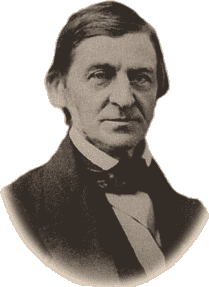 Waldo Emerson is truly the center of the American transcendental movement, setting out most of its ideas and values in a little book, Nature, published in 1836, that represented at least ten years of intense study in philosophy, religion, and literature, and in his First Series of essays.
Friday, January 09, 2004
Excluded Parties List System: "
The Department of Treasury's Office of Foreign Assets Control (OFAC) Lists and the Department of Commerce's Bureau of Industry and Security (BIS) Lists are now available on the EPLS database.
The OFAC Lists are being identified on EPLS as Specially Designated Nationals (SDN) 'SDN and Blocked Persons List' and the BIS Lists are being identified on EPLS as 'Denied Persons List'. While these Lists are available on EPLS for access at a single location, they do not replace the Lists available at the OFAC and BIS web sites. Also, these Lists have not been fully incorporated into the EPLS database and do not have Search and Report capabilities. Therefore, until further notice, users will need to check each list on EPLS to determine an entities' or individual's eligibility status. "
The Department of Treasury's Office of Foreign Assets Control (OFAC) Lists and the Department of Commerce's Bureau of Industry and Security (BIS) Lists are now available on the EPLS database.
The OFAC Lists are being identified on EPLS as Specially Designated Nationals (SDN) 'SDN and Blocked Persons List' and the BIS Lists are being identified on EPLS as 'Denied Persons List'. While these Lists are available on EPLS for access at a single location, they do not replace the Lists available at the OFAC and BIS web sites. Also, these Lists have not been fully incorporated into the EPLS database and do not have Search and Report capabilities. Therefore, until further notice, users will need to check each list on EPLS to determine an entities' or individual's eligibility status. "
Tuesday, January 06, 2004
Techdirt Corporate Intelligence: "
Techdirt Tells You What YOU Need to Know -- Now
Techdirt is your business' corporate intelligence team. We build you a private corporate intelligence web site that we stock DAILY with the analysis, news and insight you need to run your business. We partner closely with you to deliver:
Custom analysis of trends and events most important to your business
Filtered news and insight about your industry, your competition, your partners and customers
Intelligence reports with answers to your specific business challenges
We make sure you have the knowledge and tools you need at your fingertips so you can...
Get important facts quickly
Get an honest analysis of events in your industry and how they impact you
Stay ahead of your competition
Track trends and developments in your market
Measure the impact of your corporate strategy
Look for new threats and opportunities
Increase your strengths and reduce your weaknesses
...All for less than the cost of a single employee. You leave the finding, filtering, summarizing and analyzing to us. With Techdirt, you will be better informed and have more time to execute.
Techdirt Tells You What YOU Need to Know -- Now
Techdirt is your business' corporate intelligence team. We build you a private corporate intelligence web site that we stock DAILY with the analysis, news and insight you need to run your business. We partner closely with you to deliver:
Custom analysis of trends and events most important to your business
Filtered news and insight about your industry, your competition, your partners and customers
Intelligence reports with answers to your specific business challenges
We make sure you have the knowledge and tools you need at your fingertips so you can...
Get important facts quickly
Get an honest analysis of events in your industry and how they impact you
Stay ahead of your competition
Track trends and developments in your market
Measure the impact of your corporate strategy
Look for new threats and opportunities
Increase your strengths and reduce your weaknesses
...All for less than the cost of a single employee. You leave the finding, filtering, summarizing and analyzing to us. With Techdirt, you will be better informed and have more time to execute. "
[UK hynotist books. timberlake?].
Techdirt Tells You What YOU Need to Know -- Now
Techdirt is your business' corporate intelligence team. We build you a private corporate intelligence web site that we stock DAILY with the analysis, news and insight you need to run your business. We partner closely with you to deliver:
Custom analysis of trends and events most important to your business
Filtered news and insight about your industry, your competition, your partners and customers
Intelligence reports with answers to your specific business challenges
We make sure you have the knowledge and tools you need at your fingertips so you can...
Get important facts quickly
Get an honest analysis of events in your industry and how they impact you
Stay ahead of your competition
Track trends and developments in your market
Measure the impact of your corporate strategy
Look for new threats and opportunities
Increase your strengths and reduce your weaknesses
...All for less than the cost of a single employee. You leave the finding, filtering, summarizing and analyzing to us. With Techdirt, you will be better informed and have more time to execute.
Techdirt Tells You What YOU Need to Know -- Now
Techdirt is your business' corporate intelligence team. We build you a private corporate intelligence web site that we stock DAILY with the analysis, news and insight you need to run your business. We partner closely with you to deliver:
Custom analysis of trends and events most important to your business
Filtered news and insight about your industry, your competition, your partners and customers
Intelligence reports with answers to your specific business challenges
We make sure you have the knowledge and tools you need at your fingertips so you can...
Get important facts quickly
Get an honest analysis of events in your industry and how they impact you
Stay ahead of your competition
Track trends and developments in your market
Measure the impact of your corporate strategy
Look for new threats and opportunities
Increase your strengths and reduce your weaknesses
...All for less than the cost of a single employee. You leave the finding, filtering, summarizing and analyzing to us. With Techdirt, you will be better informed and have more time to execute. "
[UK hynotist books. timberlake?].
Saturday, January 03, 2004
HOW TO USE HISTORYWORLD
World History consists of some 400 separate Histories AND 4000 tagged events. Choose HISTORIES to read a chosen subject, and to move seamlessly from one History to another. Try TOURS to travel through time on your own selection of interconnecting trails. Use WHATWHENWHERE to discover what was going on at any moment.
World History consists of some 400 separate Histories AND 4000 tagged events. Choose HISTORIES to read a chosen subject, and to move seamlessly from one History to another. Try TOURS to travel through time on your own selection of interconnecting trails. Use WHATWHENWHERE to discover what was going on at any moment.
No more for him. He's on the wagon.
Journey from Newgate to Tyburn: "A Last Drink
Even in the eighteenth century the Tyburn Road or Oxford Street was a lively area, with salesmen and shoppers and people stopping for a bite to eat or for a drink. Those who found a seat in the Mason's Arms, a pub in Seymour Place, would get a special view of the prisoners, because this was their very last place to stop for food and drink. Before that they would have had a drink half way through the journey, at the Bowl Inn at St Giles.
The City Marshall knew that the utmost care had to be taken at this final stop. It was a custom for prisoners to have a drink - perhaps the alcohol would numb them before the execution. But the cellars of the pub still have the manacles on the walls, which show that prisoners enjoyed their last pint in unusual conditions.
As they left the pub and were loaded back onto the cart, prisoners would shout to customers 'I'll buy you a pint on the way back!' We might think it strange for people condemned to death to be cracking jokes, but it was just one of the many rituals that made the day such a spectacle for the thousands who, at some point, decided to watch. Some, who might have come miles to see 'the drop', were determined to have a good time - almost as though it was a holiday or they had gone to a carnival - and it was Saint Monday, a long weekend, after all! There were eight of these hanging days a year and they were considered to be the biggest tourist attraction of the day!"
Now THIS is truly amazing!
 A fully searchable online edition of the largest body of texts detailing the lives of non-elite people ever published, containing accounts of over 100,000 criminal trials held at London's central criminal court.
Now contains 45,000 trials, from December 1714 to December 1799
The Proceedings of the Old Bailey London 1674 to 1834
A fully searchable online edition of the largest body of texts detailing the lives of non-elite people ever published, containing accounts of over 100,000 criminal trials held at London's central criminal court.
Now contains 45,000 trials, from December 1714 to December 1799
Subscribe to:
Posts (Atom)